The Claude Code Leak: From Code Generation to Code Governance
This week's Claude Code leak was a wake-up call for the industry, and not just because Anthropic's internal agent harness ended up on GitHub for engineers worldwide to inspect. The more unsettling question is how it happened. In an era where AI coding agents are deeply embedded in development workflows, the line between human error and AI-assisted error is increasingly blurry. Whether or not Claude Code wrote the code that leaked itself, the incident exposed something more fundamental: in AI-accelerated development, even the builders of these tools have lost some degree of visibility and control over what ships.
At the same time, AI coding agents like Claude Code, GitHub Copilot, Cursor, and OpenAI Codex are rapidly becoming the default interface to software development. They are generating more code than ever before, faster, cheaper, and at a massive scale. The SDLC is no longer just automated; it is increasingly autonomous. But as speed accelerates, visibility is eroding. If AI agents are generating, packaging, and deploying code faster than any human reviewer can fully track, this week's incident points to a broader systemic risk: speed without provenance creates blind spots, and blind spots don't discriminate by org chart.
AI Accelerates Code Generation, But Obscures Code Origin
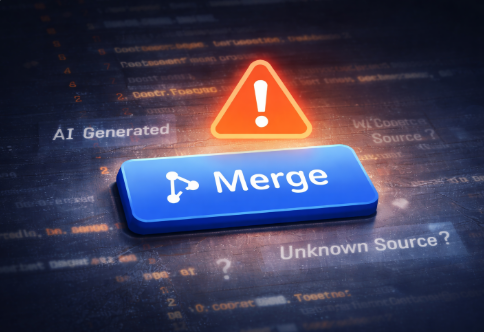
AI accelerates code generation, but it obscures code origin. Developers are now merging code they didn't fully write, from systems they don't fully understand, trained on data they cannot fully see. This breaks a core assumption of the traditional SDLC, that code has clear authorship and traceable dependencies. In its place, we are left with an uncomfortable reality: we are shipping code without knowing where it came from, or what obligations it carries.
Is your organization ready for the EU AI Act?
High-risk AI obligations are now enforceable. Check your compliance status and get a personalized gap checklist in 5 minutes, free.
Take the EU AI Act AssessmentA Governance Problem, Not Just a Security Concern
This is not just a security concern. It is a governance problem. AI-generated code can unintentionally replicate licensed or proprietary patterns, introducing risks such as copyright violations, copyleft contamination, or derivative logic into production systems. Existing safeguards including dependency tracking, license checks, and manual reviews were never designed for this level of opacity. As a result, risk is no longer explicit and reviewable; it is implicit and embedded. What's emerging is a new class of failure in the SDLC: unattributed, unverified code entering production at scale.
Governance Must Be Embedded at the Moment of Creation
What the Claude Code incident makes clear is that governance cannot begin after code ships. It has to be embedded in the moment of creation. This is not a monitoring problem; it is an infrastructure problem. The SDLC needs a control layer designed for an AI-native world, one that treats AI-generated code the way supply chain security treats third-party dependencies: verified, attributable, and auditable before it ever reaches production. That is the problem Trussed AI is built to solve.
How Trussed AI Solves This
We've built a code provenance layer that brings transparency into what has traditionally remained opaque, continuously analyzing outputs from AI coding agents to identify what is likely machine-generated and how it relates to known open-source or proprietary sources. This creates clear visibility into code origin and lineage.
Crucially, this insight is enforceable. Trussed surfaces licensing and copyright risks in real time, flags potential derivative paths, and can signal IDEs and development workflows to enforce established enterprise policies at the point of merge. High-risk code can be blocked, AI-generated contributions can require additional review, and governance can be applied consistently without slowing teams down. This marks a shift from passive compliance to active governance.
The Future of the SDLC
AI coding tools will continue to become more capable, more autonomous, and more central to how software is built. The question is no longer whether organizations will use them. It is whether they can trust what those systems produce.
The next evolution of the SDLC will not be defined by automation alone. It will be defined by control, accountability, and provenance. The teams that get this right will move fast and with confidence, knowing that every line of code they ship is not only functional, but verifiable. In an AI-first development world, that confidence isn't optional, it's the boundary between innovation and liability.
Stay current on AI regulation deadlines
Track every AI enforcement date globally, filterable by industry. Updated monthly.
View the Deadline Tracker