Scoping and Managing AI Agent Permissions
A step-by-step framework for defining agent capability boundaries, translating them into enforceable policy, and detecting drift as agents are updated over time.
AI agent permission scoping is the process of defining, enforcing, and periodically reviewing the exact tools, data, and actions an agent is authorized to use, based on its intended function. It requires translating that intent into discrete technical permissions, applying separate policy scopes across development, staging, and production, and detecting drift as the agent is updated over time.
At a glance: the four disciplines
Capability mapping, environment scoping, lifecycle review, and drift detection form the core of a working permission model. Each is covered in sequence below.
1. Defining Agent Capability Boundaries
AI agent permission scoping is the process of defining exactly which tools, data, and actions an autonomous agent is authorized to use, then enforcing that boundary through a policy layer rather than implicit trust in the agent's logic.
No standards body currently publishes a permission framework specific to AI agents. Platform teams instead apply established access control models, most commonly role-based access control (RBAC) and attribute-based access control (ABAC), to a new class of non-human subject.
NIST's RBAC model (ANSI/INCITS 359) defines roles as bundles of permissions assigned to a subject based on function, which maps reasonably well to agents performing a fixed, well-understood task. NIST SP 800-162 describes ABAC as authorization decided by attributes of the subject, resource, action, and environment, which suits agents whose permitted actions vary by context, such as data sensitivity or request origin.
Neither model was designed with agent-specific constructs like delegation depth or task scope in mind, so platform teams typically extend these models rather than adopt them unmodified. The practical starting point is the same for either approach: represent agent capabilities as discrete, enumerable permissions covering tool access, data scope, and action type, rather than a single broad role label. That granularity is what makes the least-privilege principle in NIST SP 800-53 (AC-6) enforceable in practice.
2. Translating Capabilities into Enforceable Policy
Once an agent's capability boundaries are defined conceptually, they must be expressed as machine-readable policy that a runtime enforcement layer can evaluate. This means decomposing each capability into the three dimensions most access control systems can reason about:
- Tool access: which APIs, services, or internal functions the agent may invoke
- Data scope: which records, datasets, or data classifications the agent may read or write
- Action type: whether the agent may only read, or may also mutate, delete, or trigger downstream effects
Representing these dimensions explicitly in a policy document, rather than relying on application code to enforce them, decouples the permission model from the agent's implementation. This separation allows permissions to be reviewed and updated independently of code changes, and allows an enforcement layer to apply them consistently across environments.
3. Environment-Specific Permission Boundaries
A single permission policy applied uniformly across development, staging, and production creates unnecessary risk. Development environments typically require broader access to support debugging and iteration; production environments should apply the narrowest permissions consistent with the agent's intended function.
The practical approach is to maintain separate policy definitions for each environment, derived from a common capability model but differing in scope. This allows developers to work effectively without granting production-equivalent permissions to agents running against test data, and ensures that a policy change validated in staging must be explicitly promoted to production rather than automatically inherited.
4. Permission Lifecycle and Change Management
Agent permission reviews should be tied to agent update cycles rather than a fixed calendar. When an agent's logic changes, a review of whether its granted permissions still match its actual requirements is a natural part of the release process, not a separate audit function.
Concretely, this means treating permission definitions as artifacts that accompany an agent through its development and deployment pipeline, subject to review and approval in the same way that code changes are. Permission changes should be version-controlled, and the review record should be retained alongside the policy document.
Recommended lifecycle checkpoints
-
Initial capability mapping
Before an agent is deployed, enumerate its required tools, data access, and action types. Document the business function each capability supports.
-
Pre-deployment policy review
Confirm that the policy definition matches the capability map and that permissions are scoped to the target environment. Apply least-privilege reductions where possible.
-
Post-update re-evaluation
After any significant change to an agent's logic or tooling, re-evaluate whether its permission scope remains appropriate. Revoke permissions that are no longer needed.
-
Periodic usage comparison
On a recurring basis, compare granted permissions against actual logged usage. Investigate and remediate discrepancies.
5. Detecting Permission Drift
Permission drift occurs when an agent's granted access no longer matches what it actually needs, typically because its logic changed after deployment without a corresponding permission review. This is the same problem NIST SP 800-53's account management controls (AC-2) address for any persistent account: permissions granted for a past need remain in place after that need has changed.
Detecting drift requires comparing granted permissions against actual usage on a recurring basis. In cloud environments, tools like AWS IAM Access Analyzer serve this function. Applied to agents, the same pattern means logging every permission-relevant decision separately from general application logs, then periodically checking that logged usage against the policy currently in force.
Zero Trust Architecture, described in NIST SP 800-207, offers a related but distinct control: rather than relying on a one-time authorization grant, access decisions are re-evaluated per session or request. For agents operating over long-running sessions or making repeated tool calls, this continuous verification model reduces the window in which drift can go undetected between formal review cycles.
Practical signal: usage-to-policy gap
If an agent consistently uses only a subset of its granted permissions over several review cycles, that gap is a candidate for least-privilege reduction. Conversely, repeated authorization failures may indicate that the policy has not kept pace with the agent's evolving requirements.
6. Where Runtime Enforcement Fits
The steps above describe how to design a permission model. Enforcing it in a running system is a separate concern: policy definitions only reduce risk if every tool call and data access request is checked against them at execution time, not just at deployment.
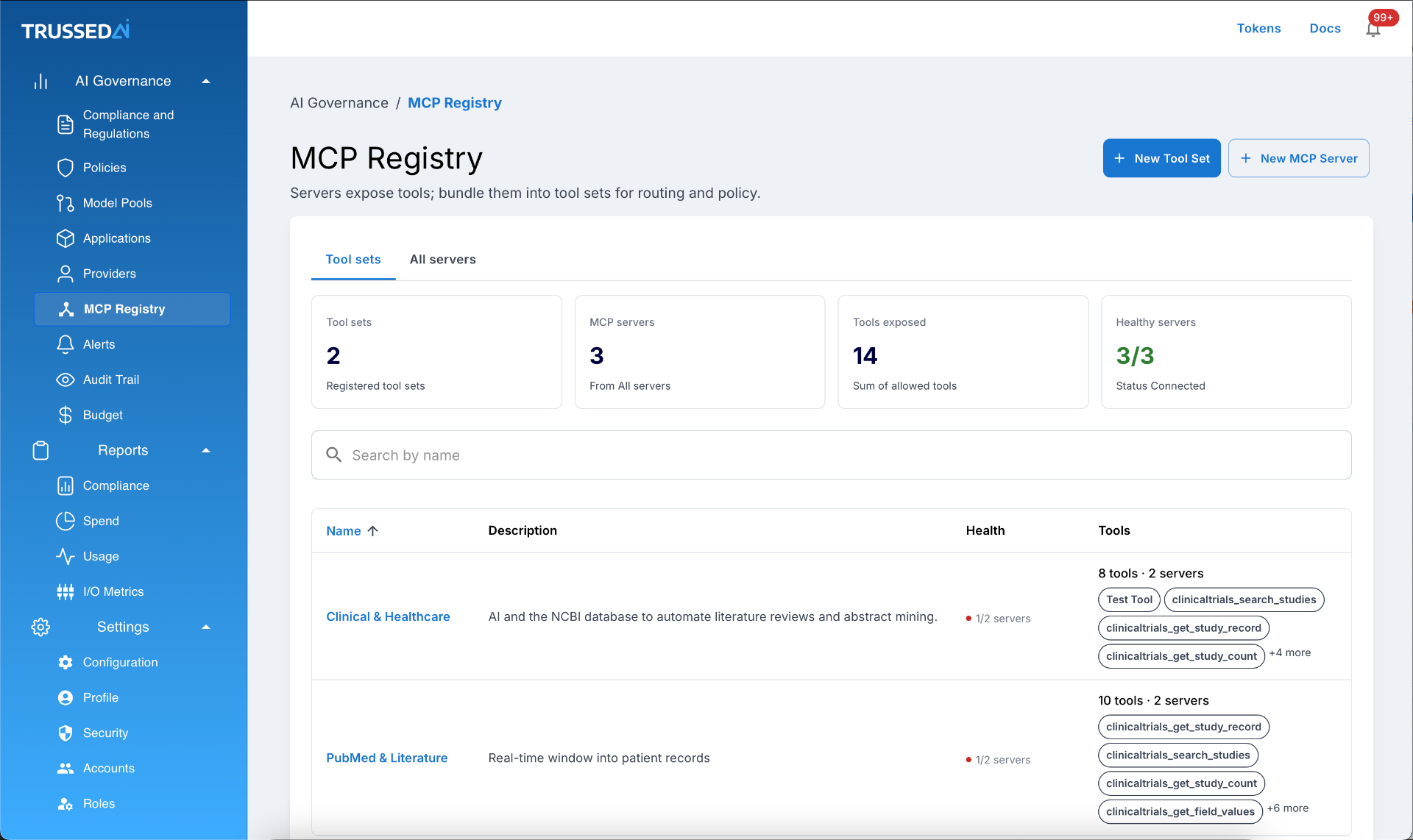
Runtime governance operates at this layer, sitting between an agent and the tools, data, and other agents it interacts with. A runtime enforcement layer checks each action against the current permission policy, supports approval workflows for actions that require explicit sign-off, and produces audit logs that record permission-relevant decisions independently of application logs.
For platform teams that have already defined capability boundaries using the process above, runtime enforcement is what keeps those boundaries applied as agents are updated, redeployed, or connected to new tools, including agent-to-agent interactions where one agent's output becomes another agent's input.
Permission Scope Reference
The following table summarizes the four disciplines described in this guide and the primary control each addresses.
| Discipline | What it addresses | Key NIST reference |
|---|---|---|
| Capability mapping | Translates a business function into discrete, enumerable permissions covering tools, data, and action types. | SP 800-53 AC-6 (Least Privilege) |
| Environment scoping | Maintains separate policy definitions for development, staging, and production to prevent overly broad access in production. | SP 800-53 CM-6 (Configuration Settings) |
| Lifecycle review | Ties permission review to agent update cycles so that capability changes trigger a re-evaluation of granted access. | SP 800-53 AC-2 (Account Management) |
| Drift detection | Compares granted permissions against actual usage on a recurring basis to identify and remediate stale or excess access. | SP 800-207 (Zero Trust Architecture) |
Frequently Asked Questions
What is the difference between RBAC and ABAC for AI agent permissions?
RBAC assigns permissions to an agent based on its functional role, which works well for agents with a fixed, well-understood task. ABAC evaluates permissions dynamically based on attributes of the agent, the resource, the requested action, and the environment. ABAC is better suited to agents whose permitted actions vary by context, such as data classification level or the identity of the user on whose behalf the agent is operating. In practice, many teams use a hybrid: RBAC to define baseline role permissions and ABAC to add contextual constraints on top of them.
How often should agent permissions be reviewed?
Reviews should be triggered by agent update cycles rather than a fixed calendar. Any time an agent's logic, tooling, or operational context changes meaningfully, its permission scope should be re-evaluated. In addition, periodic usage-versus-policy comparisons, which need not align with release cycles, help surface drift that accumulates gradually between formal reviews.
How does Zero Trust Architecture apply to agent permissions?
Zero Trust Architecture, as described in NIST SP 800-207, treats no subject as implicitly trusted based on a prior authorization grant. Applied to agents, this means evaluating access decisions at the time of each request or session rather than relying on a one-time permission grant made at deployment. For agents that operate over long-running sessions or make many sequential tool calls, continuous verification reduces the window during which undetected drift can be exploited.
What should be logged for permission auditing purposes?
Permission-relevant decisions, meaning each tool invocation, data access request, or action that was evaluated against the policy, should be logged separately from general application logs. Log entries should capture the agent identity, the resource or tool requested, the action type, the policy decision (permit or deny), and a timestamp. Keeping this log stream independent of application logs makes it easier to query for drift analysis and to present to auditors without exposing unrelated operational detail.
What distinguishes agent-to-agent interactions from standard tool calls?
When one agent's output becomes the input to another agent's tool call, the permission chain extends across both agents. The second agent's permission scope does not automatically inherit the first agent's authority. Each agent in a multi-agent workflow should be evaluated against its own policy independently, and delegation of authority between agents should be explicit and bounded rather than implicit.
Enforce Agent Permissions at Runtime
Designing a permission model is the first step. Trussed AI provides runtime governance to enforce, monitor, and audit agent permissions as agents are deployed and updated.
Explore Runtime Governance