What AI Agent Runtime Governance Means
AI agent runtime governance is the set of enforcement mechanisms applied at the point of tool invocation, rather than only at agent configuration. These mechanisms verify agent identity, restrict tool-call permissions to least privilege, and log every action so that a manipulated or compromised agent cannot self-authorize unauthorized behavior.
The distinction between configuration-time and runtime controls is the central issue. Most enterprise security frameworks inherited from conventional software assume that if a system is configured correctly before it runs, it will behave safely during execution. Agentic AI breaks this assumption because the model's reasoning, inputs, and tool-call sequences are not fully determined until the moment of execution.
The Governance Gap Behind Agentic AI Deployments
Enterprises are shifting from single-turn model outputs to agentic systems that chain multiple tool calls autonomously, frequently through Model Context Protocol (MCP)-style integrations that connect an agent or LLM host to external tools and resources. This shift changes where authorization risk lives.
In a single-turn system, a human reviews the output before anything happens. In an agentic system, the model can invoke a tool, receive a result, and invoke another tool without a human in the loop, sometimes across many steps in a single task.
Public attention on AI agent security has repeatedly circled back to this seam: the gap between what an agent is configured to do and what it can actually invoke while running. The structural pattern is consistent. MCP-style architectures place trust and authorization decisions at the tool-invocation boundary, not solely at the model layer, and most enterprise deployments were not built with a runtime enforcement layer that operates independently of the agent's own reasoning.
| Failure Pattern | Why It Occurs | Governance Implication |
|---|---|---|
| Tool-invocation boundary | Authorization decisions happen when a tool is called, not just when it is configured. | Runtime policy enforcement is required, not only setup validation. |
| Chained autonomy | Agents combine multiple low-privilege calls into higher-privilege outcomes. | Per-call permission scoping must account for compound effects. |
| Shared credentials | Agent actions often inherit a service account's permissions rather than a scoped identity. | Each agent or session needs a distinct, auditable identity. |
| Design-time policy only | Most controls validate setup, not runtime behavior during execution. | A separate enforcement layer independent of model reasoning is required. |
Runtime Enforcement Is Not the Same as Model Guardrails
It is worth being precise about terminology, because vendors use these terms loosely.
Model-level guardrails and prompt-level instructions attempt to shape what an agent decides to do. Runtime enforcement is a separate control applied at the point of tool or API invocation, independent of the model's own behavior.
A prompt instruction can be argued around, ignored, or overridden by a sufficiently adversarial input. A runtime policy check either permits the call or it does not, regardless of what the model reasoned its way into.
Key Distinction
Agent identity binding is an architectural decision separate from binding permissions to the underlying human or service account that deployed the integration. Without this separation, every agent action is indistinguishable from a direct action by whichever credential the integration was built on, which makes it difficult to scope permissions narrowly or to audit which agent, session, or task triggered a given call.
Model-Level Guardrails
- Applied inside or before the model at inference time
- Influence what the agent decides to do
- Can be overridden by adversarial prompt inputs
- Do not operate independently of model reasoning
- Provide no audit trail at the tool-invocation layer
Runtime Policy Enforcement
- Applied at the tool or API invocation boundary
- Determines whether a call is permitted to execute
- Operates independently of the model's reasoning
- Produces an auditable record for every attempt
- Enforces least-privilege regardless of model output
Governance Questions That Precede Any Tooling Decision
Runtime controls only matter if the surrounding governance framework defines what they are enforcing. Most enterprises deploying agentic AI have not yet documented several foundational policies.
Autonomy boundaries
Which tool calls require human approval versus which can execute autonomously? Without this definition, a runtime enforcement layer has no policy to apply. The absence of a stated policy means these decisions get made implicitly by whoever configured the agent, rather than by the governance function.
Accountability mapping
When an agent's tool call causes harm, responsibility may map to the deploying team, the model provider, or the tool and integration owner. Without a stated policy, accountability is determined after the fact rather than before deployment. Governance leaders should establish this mapping as a precondition for any agentic system that can take actions with external consequences.
Auditability standards
Who can review agent action logs, and how long are they retained? These standards belong in the same governance document as autonomy boundaries and accountability mapping. Log retention policies for agentic systems should be aligned with the organization's existing data governance and incident response requirements.
Independent verification
Few organizations have introduced independent verification confirming that runtime controls are actually enforced in production rather than only specified in design documents. Governance leaders should treat this as a prerequisite, not an afterthought. An internal audit or compliance review of the runtime enforcement layer provides assurance that the policy as designed matches the policy as deployed.
Implementation Priorities for Closing the Gap
Organizations can approach runtime governance incrementally. The following priorities are ordered by their impact on reducing the core authorization gap.
1. Establish agent identity separate from service credentials
Each agent, and ideally each agent session or task, should have a distinct identity that is not shared with other agents or with the human account that configured the integration. This is a prerequisite for meaningful permission scoping and for attributing actions in an audit log.
2. Apply least-privilege at the tool-call level
Permissions should be scoped to the specific tools an agent needs for a specific task, not to everything the deploying credential can access. This requires moving permission definitions from the service account layer to the agent or session layer.
3. Enforce policy at the invocation boundary, not only at setup
The enforcement mechanism should intercept each tool call and apply the current policy before permitting execution. This enforcement should be architecturally separate from the model's reasoning so that it cannot be bypassed through prompt manipulation.
4. Log every tool-call attempt, including blocked calls
An audit log that records only successful calls is insufficient for incident response. Blocked or denied calls often reveal the most important signals about manipulation attempts or configuration errors.
5. Define and document human-in-the-loop thresholds
For tool calls above a certain risk threshold, such as those involving write access to production systems, data exfiltration potential, or external communications, a human approval step should be required. These thresholds should be documented and reviewed periodically.
- Agent identity distinct from deploying service account
- Per-session or per-task permission scoping
- Runtime policy enforcement independent of model reasoning
- Audit log for every tool-call attempt, permitted and blocked
- Documented autonomy thresholds with human approval for high-risk calls
- Independent verification that production enforcement matches design policy
Evaluation Criteria for Runtime Agent Security Solutions
When evaluating tooling for runtime agent governance, the following questions help distinguish genuine enforcement from policy documentation or model-layer controls marketed as runtime governance.
| Evaluation Question | What a Strong Answer Looks Like |
|---|---|
| Where does enforcement occur? | At the tool-invocation boundary, independent of model reasoning and prompt content. |
| How is agent identity established? | Each agent or session has a distinct, scoped identity separate from the deploying service account. |
| Can a manipulated model bypass the enforcement layer? | No. The enforcement layer operates outside the model's reasoning path. |
| What is logged? | Every tool-call attempt, including blocked calls, with agent identity, timestamp, and policy decision. |
| How are permissions scoped? | At the agent, session, or task level, not inherited from a broad service account. |
| Does it support human approval workflows? | Yes, with configurable thresholds for which call types require human review before execution. |
| Does it work with MCP-style integrations? | Policy enforcement applies at the MCP tool-call boundary, not only at the model or orchestrator layer. |
How This Maps to Trussed AI
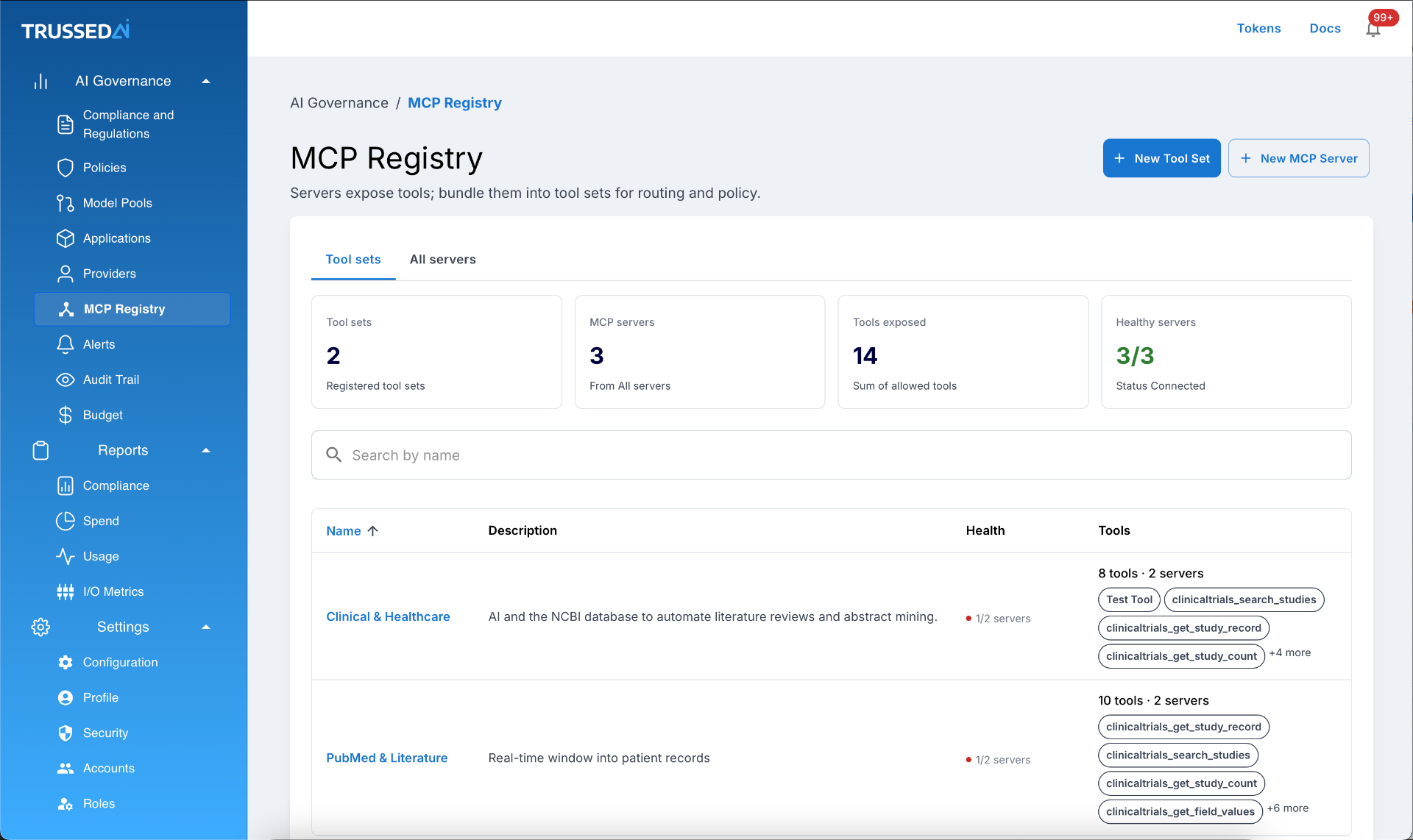
Trussed AI focuses on runtime governance and security for enterprise AI agents. Its capability areas include runtime policy enforcement, agent identity, least-privilege permissions, tool approval workflows, and audit logging.
These capabilities map directly to the gaps described above: enforcing tool-call policy at the point of invocation rather than only at setup, assigning agents a distinct identity apart from shared credentials, and producing an audit record for every call an agent attempts, whether permitted or blocked.
The intent is not to replace an enterprise's existing governance policy, but to give it a runtime mechanism that can actually be enforced in production, including within MCP-based tool integrations.
Frequently Asked Questions
What is the difference between model guardrails and runtime enforcement?
Model guardrails attempt to influence what the model decides to do at inference time. Runtime enforcement is a separate control applied at the tool or API invocation boundary, independent of the model's behavior. A runtime policy check either permits or blocks a call regardless of the model's reasoning, which is why it cannot be bypassed through prompt manipulation in the way that model-level instructions can.
Why does agent identity matter for governance?
If an agent's actions are attributed to a shared service account, it is impossible to determine which agent, session, or task triggered a specific tool call. This prevents meaningful permission scoping, makes incident response difficult, and creates an accountability gap when an agent action causes harm. A distinct agent identity is the foundation for least-privilege enforcement and audit attribution.
What is an MCP-style architecture and why does it create governance exposure?
Model Context Protocol (MCP) is a pattern for connecting an LLM host or agent to external tools and resources through a standardized interface. It places trust and authorization decisions at the tool-invocation boundary, which means that if no enforcement layer exists at that boundary, the model's ability to invoke tools is limited only by what the underlying credential can access, not by any scoped agent-level policy.
What governance documents should exist before deploying agentic systems?
At minimum: a documented list of which tool calls require human approval versus autonomous execution, an accountability mapping identifying responsibility for agent-caused harm, auditability standards covering log retention and access, and a record of independent verification confirming that production enforcement matches design policy. These documents give the runtime enforcement layer a defined policy to apply.
Is runtime enforcement sufficient on its own?
No. Runtime enforcement is necessary but not sufficient. It must be paired with a governance framework that defines the policies being enforced, an agent identity architecture that enables meaningful permission scoping, audit logging that captures blocked as well as permitted calls, and periodic independent verification that the enforcement layer is operating as designed in production.