See how Trussed maps to SEC in 20 minutes

    No generic demo, just the controls relevant to your program.

    Book a session
    AI Agent Security

    AI Agent Runtime Governance: What Recent Security Incidents Reveal

    AI agent runtime governance is the set of controls, including agent identity verification, permission scoping, policy enforcement at the point of tool invocation, and tamper-evident audit logging, that governs what an autonomous agent is allowed to do at the moment it acts. It is distinct from controls that only filter what an agent generates as text.

    The Four Pillars of Runtime Governance

    Runtime governance applies across four interdependent control areas. Each addresses a distinct point of failure that static or prompt-level controls cannot reach.

    Agent Identity

    Verified per instance and session, not inherited from a shared credential.

    Permission Scoping

    Enforced per tool and per action rather than granted broadly at deployment time.

    Policy Enforcement

    Applied at the point of tool invocation, not only at the prompt layer.

    Audit Logging

    Captures the full decision chain for every tool call, not just post-hoc application logs.


    Why Agent Tool-Call Governance Is Under Scrutiny

    Enterprises are moving autonomous AI agents into production with broad access to internal tools, external APIs, and dynamically discovered integrations such as Model Context Protocol servers. As this access expands, security teams have reported a recurring pattern: agents whose actions were hijacked through manipulated inputs, tool registries that allowed unauthorized tool-call execution, and MCP-style integrations invoked without the runtime checks that would normally apply to a human operator or a scoped service account.

    These are not failures of the underlying language model. They are failures of the infrastructure that is supposed to sit between the agent's decision to act and the system that carries out the action. Where that infrastructure is missing or incomplete, an agent's output can translate directly into an unauthorized action with no independent checkpoint in between.


    The Common Failure Point: Missing Runtime Enforcement

    Across these categories of incidents, the underlying gap is consistent: policy decisions are being made, if at all, before or after the tool call rather than at the moment of execution. Prompt-level guardrails and output moderation operate on text generation. They do not evaluate whether a specific agent, in a specific session, should be permitted to invoke a specific tool with a specific set of parameters.

    Without a runtime enforcement point, an agent that has been manipulated into requesting an unauthorized action has no technical barrier preventing that action from executing, because the system was never designed to ask whether the request should be allowed in the first place.

    Key distinction for vendor evaluation: Model-level safety controls and runtime governance controls address different threat surfaces. They are not substitutes for one another.


    What Runtime Governance Must Verify at Each Tool Call

    An effective runtime governance layer evaluates several conditions at the moment of tool invocation, before execution proceeds:

    Verification Point What It Addresses
    Agent identity Confirms the requesting agent is who it claims to be, scoped to the current session rather than relying on a shared or inherited credential.
    Tool authorization Checks whether this agent, in this context, is explicitly permitted to invoke the requested tool.
    Parameter validation Evaluates whether the specific parameters being passed fall within allowed ranges and do not encode policy-violating payloads.
    Session and context state Determines whether the request is consistent with the agent's stated task and the accumulated context of the session.
    Least-privilege confirmation Ensures the agent is not requesting permissions beyond those required for the stated action at the stated time.
    Tamper-evident logging Records the full decision and its inputs in a form that supports forensic review without requiring reconstruction from application logs.

    Governance Questions This Raises for Security Leadership

    The absence of a documented least-privilege model for agent tool access creates real ambiguity during incident response. Without clear scoping, it is difficult to state with confidence what an agent was authorized to do at the time of an event. Inconsistent enforcement across business units compounds this, since agents deployed by different teams may operate under different, undocumented assumptions about access.

    Governance frameworks also need to resolve a more basic question before implementation begins: are agent actions treated as machine-identity actions subject to existing IAM policy, or as a distinct risk category requiring new controls? That decision affects:

    • Who owns agent identity lifecycle management
    • How audit data is routed to existing SIEM and SOC tooling
    • How control effectiveness is demonstrated to internal risk committees and external auditors

    Evaluation Criteria for Runtime Governance Platforms

    When assessing vendors or building internal capability, security leaders should evaluate whether the platform addresses each of the following areas:

    • Runtime enforcement positioned between the agent's decision layer and the tool execution layer, not only at the prompt or output layer
    • Per-session agent identity that does not rely on shared service credentials
    • Tool-level and action-level permission scoping with explicit least-privilege defaults
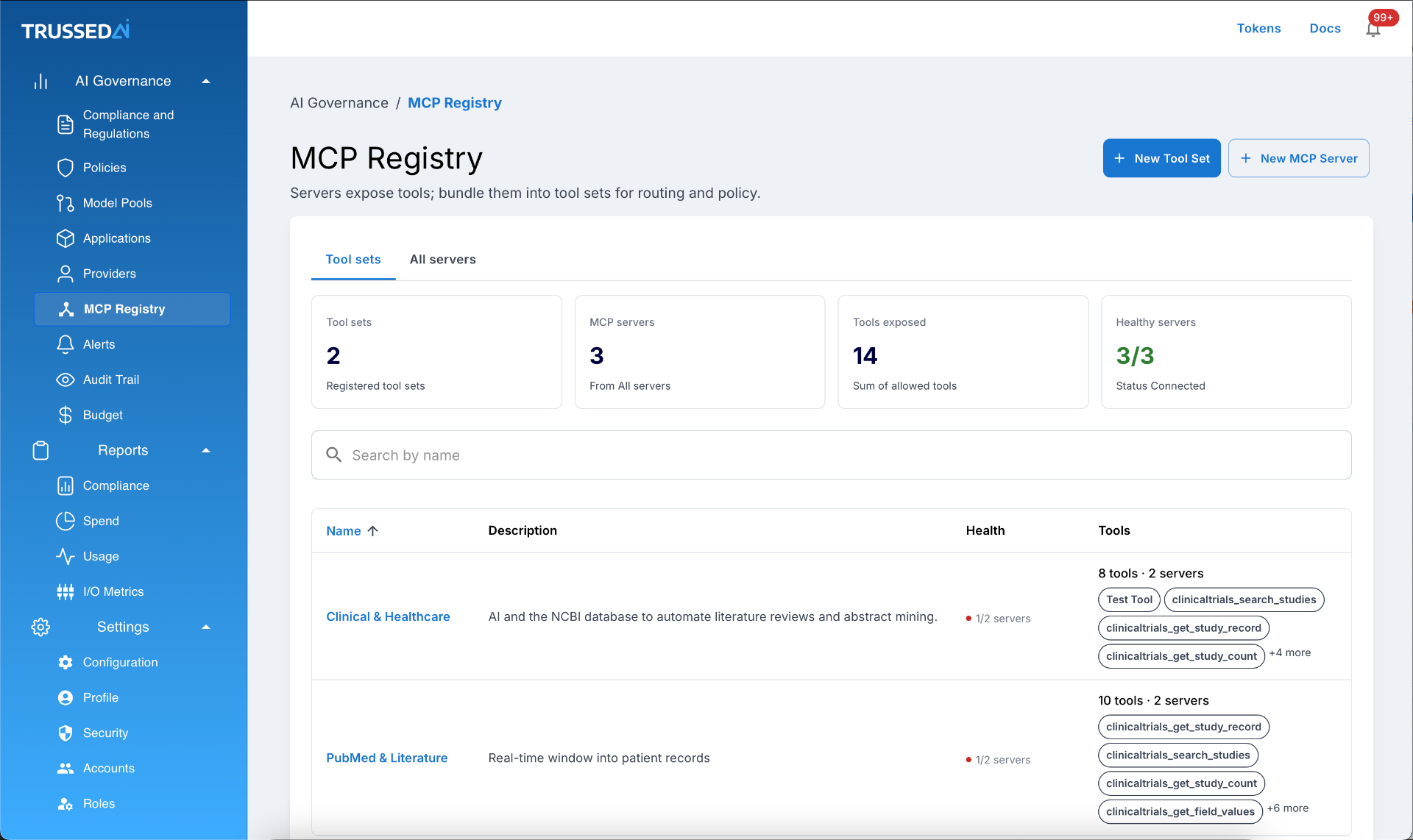
    • Coverage of dynamically registered tool sources, including MCP servers and third-party integrations discovered at runtime
    • Audit logs that capture the full decision chain per tool call, not only aggregate application logs
    • Integration paths to existing SIEM, SOC, and IAM infrastructure without requiring bespoke pipelines
    • Support for human-in-the-loop escalation for high-risk or ambiguous tool-call requests

    Implementation Decisions Before Production Rollout

    Before deploying agents into production environments with access to sensitive tools, organizations should address several implementation questions:

    • Define the agent identity model: will each agent instance receive a unique, session-scoped identity, or will identities be reused across instances?
    • Establish a tool inventory: enumerate every tool, API, and integration the agent may invoke, and assign explicit authorization policy to each.
    • Classify tool risk: not all tools carry equivalent risk; file reads, external API calls, and database writes warrant different enforcement thresholds.
    • Determine escalation paths: specify which tool-call scenarios require human review before execution can proceed.
    • Define audit retention and routing: establish where runtime logs are stored, how long they are retained, and how they are surfaced to SOC analysts.
    • Plan for drift: agent capabilities and tool registries change over time; build processes for reviewing authorization policy when integrations are added or modified.

    Frequently Asked Questions

    Is runtime governance the same as prompt injection defense?

    No. Prompt injection defenses attempt to detect or filter malicious instructions within an agent's input before the model processes them. Runtime governance operates after the model has produced a decision to act. It evaluates whether that action, as requested, is authorized, regardless of how the request was generated. A complete security posture requires both, but they address different points in the execution chain.

    Why are existing IAM and RBAC systems insufficient for agent governance?

    Traditional IAM systems are designed around human identities and long-lived service accounts. AI agents operate at a different granularity: a single agent may invoke dozens of tools within a single session, and the appropriate permissions may vary by task context rather than by static role. Applying broad service-account permissions to agents collapses the enforcement granularity that least-privilege models require. Runtime governance adds per-call, per-context enforcement that existing IAM systems are not architected to provide.

    Does this apply to multi-agent systems, or only single-agent deployments?

    Multi-agent architectures introduce additional complexity. An orchestrator agent delegating tasks to sub-agents can create chains of tool-call requests where the original authorization context is not automatically inherited or verified at each step. Runtime governance frameworks must account for delegation chains and verify authorization independently at each tool invocation, regardless of whether the requesting agent is acting autonomously or under instruction from another agent.

    What does audit logging need to capture that standard application logs do not?

    Standard application logs typically capture that a tool was called and whether it succeeded. Runtime governance logging must capture the decision context: which agent made the request, what identity and session credentials were verified, what policy was evaluated, what parameters were passed, and whether the call was permitted, blocked, or escalated. This decision chain is what enables accurate incident reconstruction and supports audit assertions about what the agent was and was not authorized to do.

    How does Model Context Protocol affect the governance surface?

    MCP and similar protocols allow agents to discover and invoke tools dynamically, rather than relying on a static, pre-approved list. This expands the governance surface significantly: a tool that was not enumerated at deployment time may become available during a session. Effective runtime governance must extend to dynamically registered tools, applying the same identity verification and permission scoping as to statically defined integrations, not treating dynamic registration as implicit authorization.

    Evaluate Runtime Governance Before the Next Incident, Not After

    Trussed AI provides runtime governance and security for enterprise AI agents, including agent identity, permission scoping, runtime policy enforcement, and audit logging for tool-call activity across agent and MCP-based deployments.

    Request a Demo