See what Trussed catches that your current tool misses, live in your stack

    No migration, no commitment, just a direct comparison in your environment.

    Set up a technical evaluation
    AI Governance & Risk

    AI Governance in M&A Due Diligence: How Buyers Are Pricing Undocumented AI Risk

    AI governance diligence examines whether a target company's AI agents and generative AI integrations are inventoried, identity-scoped, permission-limited, and auditable. Where controls are absent, buyers are treating the gap the same way they treat unremediated cybersecurity findings: as a factor that informs representations and warranties, indemnity scope, and escrow sizing.

    Best Practices Guide — AI Governance

    What Diligence Teams Are Now Examining

    AI governance diligence extends existing IT and security diligence practices to cover a target company's AI agent deployments and generative AI tool integrations. Rather than treating AI as a single line item, diligence teams request the same category of evidence they would for cybersecurity: system inventories, architecture documentation, access control models, and logging capability.

    This mirrors the structure of NIST's AI Risk Management Framework, which organizes lifecycle risk into Govern, Map, Measure, and Manage functions, and ISO/IEC 42001's requirement that organizations maintain documented AI system inventories and risk treatment records.

    The core diligence question is straightforward: does the target know what AI agents exist in its environment, and can it demonstrate control over what those agents can access and do?

    Diligence Area What Teams Look For
    Agent Inventory A complete, current record of AI agents and tool integrations, including shadow deployments outside central oversight.
    Identity & Permissions Whether agents run under scoped, distinct identities rather than shared or inherited credentials.
    Audit Trails Immutable logs of agent tool calls and data access, distinct from general application logs.
    Policy Enforcement Whether tool-call and plugin invocations pass through a governed policy point before execution.

    The Shadow AI Problem in Target Environments

    Shadow AI, meaning AI tools or agent integrations deployed outside an approved inventory, parallels the shadow IT and shadow SaaS patterns that security diligence has addressed for years. What differs is the blast radius. An AI agent with unmediated API access to production systems can take autonomous actions across multiple tools in a single session, not just retrieve data.

    Diligence teams look for signs that agent deployment outpaced governance:

    • Business units or engineering teams standing up generative AI integrations without a corresponding central inventory entry
    • Agents operating without a distinct identity or explicit permission scope
    • No logging that captures what the agent actually did versus what it was authorized to do
    • No approval workflow before agents invoke external tools or plugins

    Why this matters for deal risk

    Unlike an undisclosed SaaS subscription, an ungoverned AI agent may have already acted on production data, customer records, or financial systems with no audit trail. The exposure window is retroactive, not just prospective.

    Technical Evidence Diligence Teams Request

    When preparing for or responding to AI governance diligence, teams typically request documentation in the following areas:

    • AI system inventory with deployment dates
    • Third-party AI tool and API integration list
    • Agent identity and credential architecture
    • Permission scope documentation per agent
    • Audit log samples for agent tool calls
    • Tool approval or allowlist policies
    • Incident or anomaly records involving AI systems
    • Training data provenance records

    The absence of any of these categories is itself a finding. A target that cannot produce an agent inventory within a reasonable diligence window signals a governance posture that will require post-close remediation investment.

    From Technical Findings to Deal Mechanics

    Findings from AI governance diligence are generally treated as remediation items with associated cost and timeline estimates, similar to how unresolved cybersecurity findings have been handled in prior diligence cycles.

    Deal teams are adapting existing cybersecurity diligence precedent to AI-specific findings rather than applying a fixed formula. The practical implications typically include:

    • Representations and warranties: Extended, by analogy to existing data-privacy and IT-security reps, to cover AI system inventories, training data provenance, and third-party AI tool usage.
    • Escrow and holdback sizing: Estimated remediation cost for implementing identity, least-privilege, and logging controls can inform escrow sizing discussions.
    • Post-closing integration plans: Commonly define a remediation period for AI governance gaps, often tied to indemnification survival periods.
    • Indemnity scope: Specific caps or purchase-price adjustment formulas tied to AI findings are not yet standardized publicly; buyers are adapting precedent deal by deal.

    Buyer posture

    AI governance gaps are not yet automatic deal blockers in most transactions. The question is whether the gap is documentable, remediable, and priceable. Buyers who can quantify remediation cost have more leverage than those who cannot.

    Questions Buyer Diligence Teams Are Asking

    The following questions represent the current scope of AI governance diligence in enterprise M&A contexts:

    1. Does the company maintain a formal inventory of all AI agents and generative AI integrations, including those deployed by individual business units?
    2. Do AI agents operate under distinct, scoped service identities, or do they inherit shared credentials?
    3. Is there a policy enforcement point that mediates agent tool calls and plugin invocations before execution?
    4. Are agent audit logs immutable, tamper-evident, and stored separately from general application logs?
    5. Has the company conducted an AI risk assessment aligned to NIST AI RMF, ISO/IEC 42001, or an equivalent framework?
    6. Are any AI systems in scope for EU AI Act high-risk obligations, and has the required technical documentation been produced?
    7. What is the process for approving new AI agent deployments or third-party AI tool integrations?
    8. Have there been any AI-related incidents, anomalies, or unauthorized data access events in the past 24 months?

    Frameworks Informing Maturity Assessment

    Diligence teams reference a small set of published frameworks to structure AI governance maturity assessments rather than relying on ad hoc criteria.

    Framework Diligence Application
    NIST AI RMF 1.0 + AI 600-1 Lifecycle structure for identifying third-party and integrated tool risk across Govern, Map, Measure, and Manage functions.
    ISO/IEC 42001 Certifiable management system standard against which a target's documented practices and inventory records can be benchmarked.
    EU AI Act Risk-tiered obligations used as an exposure lens, including for targets outside direct EU jurisdiction, given extraterritorial reach for systems affecting EU markets.
    MITRE ATLAS + OWASP LLM Top 10 Technical taxonomy covering excessive agent agency and insecure plugin design, used to categorize findings consistently across deals.

    How Runtime Governance Reduces Future Diligence Exposure

    Many of the gaps diligence teams flag, including missing agent identity, absent least-privilege enforcement, incomplete audit trails, and unmediated tool-call access, are runtime governance problems rather than one-time documentation exercises.

    Addressing them requires ongoing enforcement:

    • Agent identity and permission scoping applied at runtime, not configured once and forgotten
    • Tool approval workflows that mediate access before an agent acts, not post-hoc log review
    • Audit logging that captures agent behavior continuously, producing records a diligence team can actually inspect

    Building these controls before a diligence process begins reduces the volume of undocumented findings a buyer's team encounters, and shifts the conversation from remediation cost to validated governance maturity.

    AI Governance Diligence: Common Questions

    Is AI governance diligence standard practice in enterprise M&A today?
    It is becoming standard in technology and software transactions and is appearing more frequently in deals where AI agents or generative AI integrations are material to the target's product or operations. The practice is adapting cybersecurity diligence precedent rather than following a fixed AI-specific protocol.
    What is the most common AI governance finding in diligence?
    The most common finding is an incomplete or absent agent inventory. Targets often have AI tools deployed by individual teams that are not reflected in any central system of record. This is the direct analogue of shadow SaaS, and it typically triggers follow-on requests about identity, permissions, and logging.
    Do AI governance gaps typically block deals?
    Not typically. Gaps are generally treated as remediation items that inform reps and warranties, indemnity scope, and escrow sizing rather than as automatic deal blockers. The buyer's ability to quantify remediation cost is important: well-scoped findings are priceable, while undocumented findings create more uncertainty.
    Which regulations are most commonly referenced during AI governance diligence?
    NIST AI RMF 1.0, ISO/IEC 42001, and the EU AI Act are the most commonly referenced. MITRE ATLAS and the OWASP Top 10 for LLM Applications provide a technical finding taxonomy. Regulatory applicability depends on the target's geography and customer base, but the EU AI Act is increasingly used as an exposure lens even for targets without direct EU operations.
    How long does it take to remediate AI governance gaps post-close?
    Remediation timelines depend on the number of ungoverned agents, the existing identity and access management infrastructure, and whether a runtime governance platform is being introduced. Basic inventory and identity scoping work can often be completed in weeks; full audit logging and policy enforcement integration typically takes one to three months for a mid-sized environment.
    How does Trussed AI address the gaps diligence teams flag?
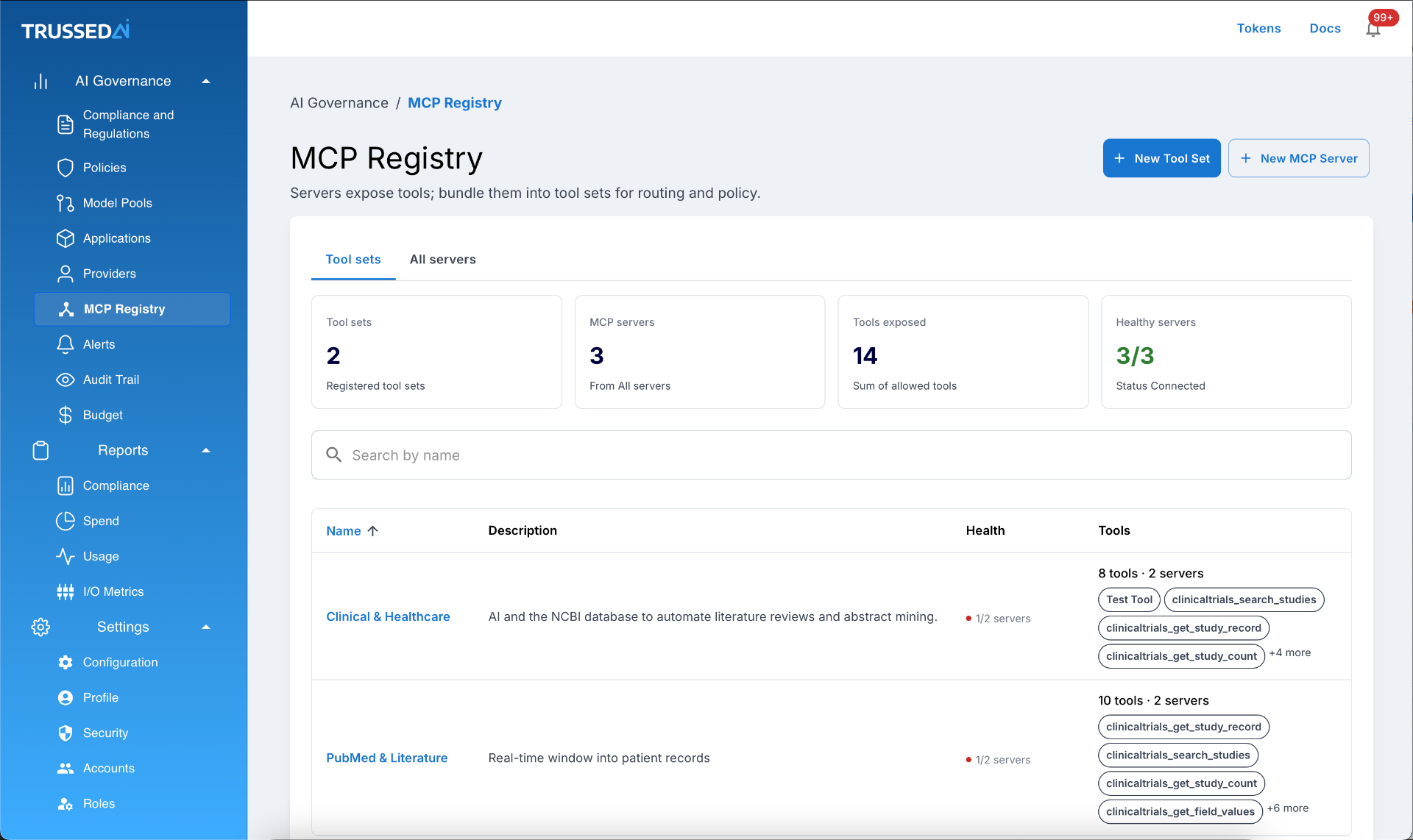
    Trussed AI provides runtime governance and security for enterprise AI agents, covering agent identity, least-privilege permissions, tool approval workflows, and audit logging. These controls directly address the categories diligence teams examine and produce documented evidence rather than requiring reliance on unverifiable representations.

    Reduce Undocumented AI Risk Before It Reaches Diligence

    Runtime governance for AI agents, covering identity, least-privilege access, and audit logging, gives risk leaders documented evidence rather than unverifiable representations.

    Request a Demo