Implementing Tool-Call Governance for Healthcare AI Agent Deployments
A practical framework for enterprise architects governing which tools AI agents can invoke inside healthcare systems, covering policy placement, risk tiering, IAM integration, audit controls, and escalation design.
In this guide
What Tool-Call Governance Means for Healthcare AI Agents
Tool-call governance is the set of controls that determine which external tools, APIs, and clinical systems an AI agent is permitted to invoke, under what conditions, and with what level of human oversight. In agentic deployments, the agent's reasoning component can initiate actions against downstream systems, such as querying a clinical database, submitting an order, or transmitting data externally, without a human explicitly authorizing each individual action.
This shifts a portion of access-control enforcement from the point of human interaction to the point of automated tool invocation. Healthcare enterprise architects typically inherit existing access-control obligations from the HIPAA Security Rule, including unique user identification, audit controls, and the minimum necessary standard for PHI access, and must extend those obligations to cover agent-initiated actions rather than only human sessions.
NIST's AI Risk Management Framework and NIST SP 800-53's access control and audit families provide adaptable, general-purpose guidance. No healthcare-specific standard currently prescribes a required tool-call governance architecture. Implementation decisions, not a fixed compliance checklist, determine whether an agent deployment introduces an unmanaged access path into clinical systems.
Governance obligations established for human user sessions must be explicitly extended to agent-initiated tool calls. An agent acting without human authorization per action does not reduce the obligation; it changes where enforcement must occur.
Where Policy Enforcement Should Sit
Tool-call governance is commonly implemented as a mediation layer positioned between an agent's reasoning component and downstream clinical or enterprise systems, rather than embedded directly in the model. Each placement option carries a different trust boundary and set of tradeoffs.
| Placement Option | How It Works | Key Tradeoffs |
|---|---|---|
| Orchestration layer | Policy is evaluated inside the agent orchestrator before a tool call is dispatched. | Tight coupling to agent logic; easier to implement initially, harder to enforce consistently across multiple agent types. |
| API gateway | An existing API gateway intercepts all outbound tool requests and evaluates policy. | Reuses existing infrastructure; may lack the contextual metadata needed for risk-tiered decisions. |
| Dedicated proxy service | A purpose-built governance proxy sits between all agents and all tools, evaluating every call. | Centralized visibility and consistent enforcement; introduces a latency dependency and a potential single point of failure. |
The appropriate placement depends on the number of agent types deployed, whether a central API gateway already exists, and the degree of contextual metadata available at each decision point. A dedicated proxy service offers the most consistent enforcement surface when multiple agent types must be governed uniformly.
A Step-Based Implementation Framework
The following sequence reflects the decisions and artifacts that must be in place before a governance layer can reliably enforce policy in a production healthcare environment.
-
01Build a complete tool inventory
Document every tool, API endpoint, and clinical system that any agent in scope is permitted to invoke. Include the action type (read, write, trigger), the data sensitivity class, and the downstream system's criticality level. Governance cannot be consistently applied to tool calls that are not formally inventoried.
-
02Define a risk-tier taxonomy
Classify each inventoried tool call into a risk tier based on data sensitivity, action type, and downstream system criticality. A practical starting structure is three tiers: low risk (read-only, non-PHI), medium risk (read PHI or write non-clinical), and high risk (write PHI, trigger clinical actions, or transmit data externally). The taxonomy must be documented and approved by clinical and security stakeholders before policy rules are written.
-
03Map agent identities to existing IAM controls
Assign each agent a governed identity within existing role-based or attribute-based access control (RBAC or ABAC) infrastructure. Avoid creating a parallel access path outside IAM. Map agent roles to scopes that reflect the minimum necessary standard for the agent's clinical function, and document the mapping for audit purposes.
-
04Author policy rules for each tier
Write allow, deny, and escalate rules for each risk tier. Unmatched requests, those not covered by any existing rule, must default to denial or escalation rather than implicit allow. Document the rationale for each rule and the identity and role context required for an allow decision.
-
05Define escalation workflows
For high-risk or unmatched tool-call requests, specify a human review authority, expected response time, and fallback behavior when a reviewer is unavailable. Escalation paths should align with existing clinical governance and incident response accountability structures rather than requiring a new reviewer role.
-
06Validate in shadow mode before enforcement
Run the governance layer in shadow mode (logging decisions without blocking) for a defined period. Compare observed decisions against expected outcomes for a representative sample of tool calls. Identify policy gaps, unmatched requests, and false positives before enabling enforcement.
-
07Enable enforcement and establish an audit trail
Activate the governance layer in enforcement mode. Ensure every tool-call decision, including the requesting agent identity, the tool invoked, the policy rule applied, and the decision outcome, is written to an immutable audit log. Treat this log as an extension of existing HIPAA audit control and retention requirements.
Evaluation Criteria for Allow, Deny, or Escalate Decisions
A governance policy engine evaluating an inbound tool-call request should consider the following criteria for each decision. All criteria should be evaluated together; a single criterion in isolation is insufficient for a reliable decision.
- Identity and role context of the requesting agent and its authorized scope within IAM.
- Requested action type and its position in the defined risk-tier taxonomy.
- Sensitivity of the data involved, evaluated against the minimum necessary standard.
- Criticality of the downstream clinical system being invoked.
- Whether the request matches an existing policy rule. Unmatched requests default to denial or escalation, not allow.
- Availability and expected response time of a human reviewer for escalated requests.
Core governance elements at a glance
Decide whether enforcement sits at the orchestration layer, an API gateway, or a dedicated proxy service.
Classify tool calls by data sensitivity, action type, and downstream system criticality.
Map agent identities to existing RBAC or ABAC controls rather than building a parallel access path.
Define human review authority for high-risk or unmatched tool-call requests.
Operational Considerations for Rollout
The following considerations apply when integrating a governance layer into an existing healthcare enterprise environment. They are not exhaustive but reflect the coordination points most commonly overlooked during initial deployment.
- Coordinate governance rollout with existing change-control and clinical system access review processes to avoid duplicate or conflicting approvals.
- Define escalation workflows that align with existing clinical governance and incident response accountability structures rather than creating a separate reviewer role.
- Treat audit trail retention for tool-call decisions as an extension of existing HIPAA audit control and retention requirements, including retention period and access controls on the log store.
- Document how the governance architecture maps to HIPAA and the NIST AI RMF for audit purposes. No healthcare-specific certification currently exists for this control area, so documentation of architectural decisions carries significant weight in an audit.
- Plan for policy maintenance as agents, tools, and clinical systems change. A static policy inventory becomes a liability if it is not updated when the tool surface changes.
Known Risk Patterns and Current Limitations
Public, healthcare-specific data on tool-call governance implementation challenges is limited. The closest available evidence comes from adjacent AI security guidance. OWASP's work on LLM and agentic application security identifies the following as recurring risk patterns in agentic deployments generally:
- Excessive agency: an agent is granted more tool scope than its clinical function requires.
- Insecure tool design: tools accept inputs from an agent without the same validation applied to human-initiated calls.
- Unauthorized privilege escalation: an agent acquires capabilities beyond its assigned scope through chained calls or prompt manipulation.
- Cascading actions across chained tool calls: a single point of insufficient scoping propagates through several downstream actions when an agent chains multiple tool calls, such as querying a record and then submitting an update.
These patterns are directly relevant to healthcare agent deployments. Architects should treat the absence of healthcare-specific implementation case data as a reason for more conservative defaults, such as denying or escalating unmatched requests, rather than a reason to defer governance until sector-specific standards mature.
When a tool-call request does not match any policy rule, the default decision should be denial or escalation to a human reviewer, not implicit allow. This is the single most consequential default to configure correctly.
Frequently Asked Questions
Does HIPAA explicitly require a tool-call governance layer for AI agents?
HIPAA does not explicitly address AI agents or tool-call governance. However, the HIPAA Security Rule's requirements for unique user identification, audit controls, and the minimum necessary standard for PHI access apply to agent-initiated actions. Whether a dedicated governance layer is required depends on how those obligations are fulfilled in the specific architecture. No healthcare-specific standard currently prescribes a required tool-call governance architecture.
Can an API gateway serve as the policy enforcement layer?
Yes, an existing API gateway can function as the enforcement layer, and doing so reuses existing infrastructure. The primary limitation is that API gateways may lack the contextual metadata needed for risk-tiered decisions, such as the requesting agent's clinical role or the sensitivity classification of the data being accessed. Architects should evaluate whether the gateway can be enriched with that context before relying on it as the sole enforcement point.
What should happen when a tool-call request does not match any policy rule?
Unmatched requests should default to denial or escalation to a human reviewer. An implicit allow default for unmatched requests is the most common source of unmanaged access paths in agentic deployments. The default must be explicitly configured and documented.
How does shadow mode validation work in practice?
Shadow mode means the governance layer evaluates every tool-call request and logs the decision it would have made, but does not actually block or escalate any call. The shadow-mode period allows architects to compare the governance layer's decisions against expected outcomes, identify gaps in policy coverage, and tune rules before enforcement is activated. A representative sample of tool calls, including edge cases and high-risk scenarios, should be reviewed before switching to enforcement mode.
How should agent identities be managed within existing IAM infrastructure?
Each agent should be assigned a governed identity within existing RBAC or ABAC infrastructure, with scopes mapped to the minimum necessary standard for the agent's clinical function. Avoid creating a parallel access path outside IAM. The agent identity-to-scope mapping should be documented, reviewed by security stakeholders, and included in the audit trail.
Does tool-call governance need to be rebuilt for each AI agent framework?
When a governance proxy or mediation layer is positioned between all agents and all downstream systems, it can enforce policy consistently regardless of which agent framework generated the tool call. This is one advantage of a dedicated proxy placement over governance logic embedded inside a specific orchestration framework.
Plan Tool-Call Governance for Your AI Agent Deployments
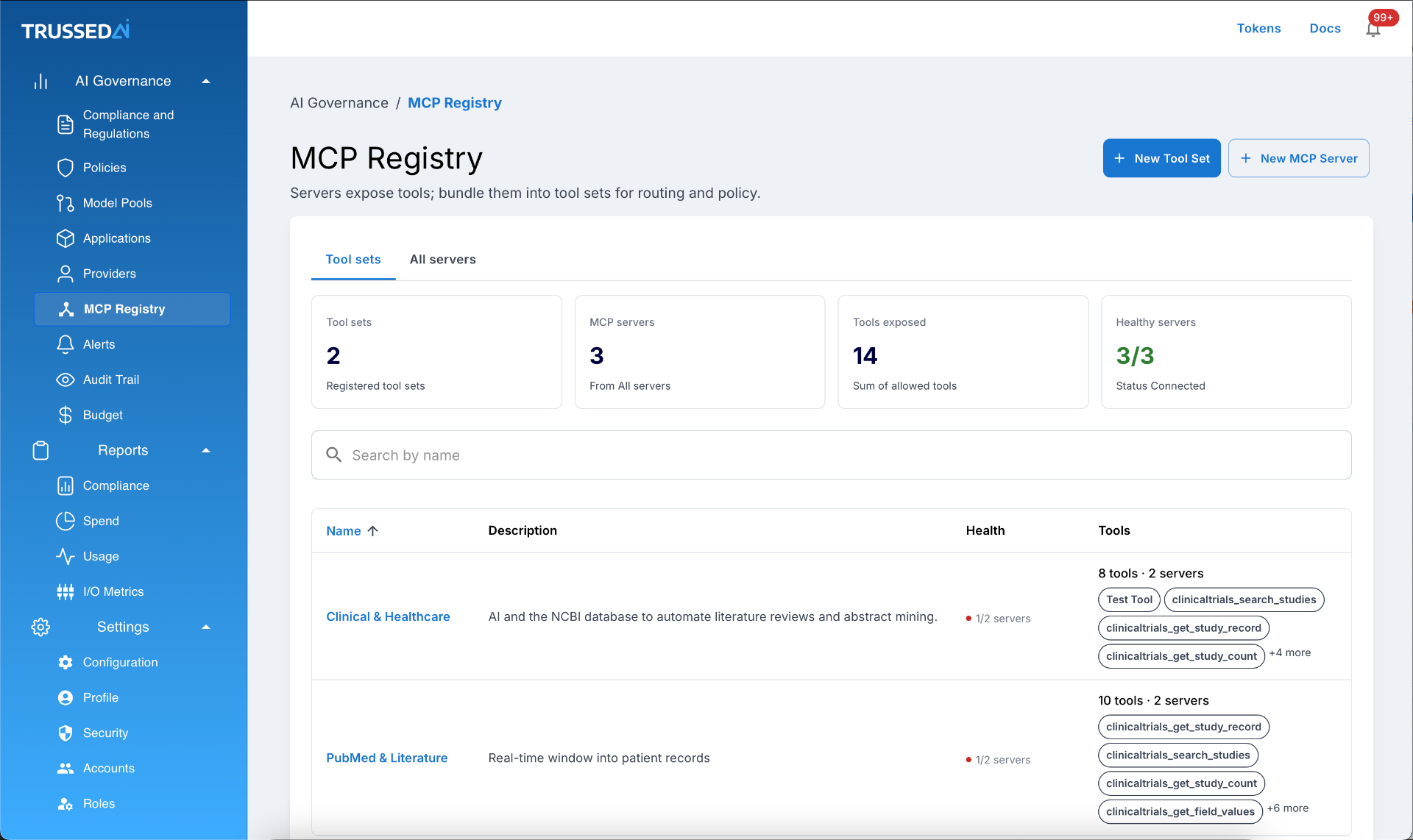
Trussed AI provides runtime governance and policy enforcement for enterprise AI agents, including agent permissions, least-privilege tool controls, and audit logging designed to sit at the tool-invocation layer.
Request a Demo