Insurance AI Compliance at a Glance
The table below summarizes the four themes that recur across current state and NAIC regulatory expectations for AI systems in insurance.
| Theme | What It Means in Practice |
|---|---|
| Regulatory Scope | State regulators and NAIC guidance address AI used in underwriting, claims, and customer service, with expectations that continue to expand. |
| The Agent Gap | Requirements built around static model review do not automatically cover AI agents that act autonomously across systems. |
| Technical Controls | Identity, least privilege, policy enforcement, and logging are implied by oversight expectations even where not named explicitly. |
| Audit Readiness | Demonstrable compliance depends on being able to reconstruct what an agent did, under what authorization, on demand. |
The Compliance Landscape for Insurance AI
Insurance carriers now run AI systems across underwriting, claims processing, and customer service, placing these systems inside an active and expanding set of regulatory expectations. State insurance regulators, along with NAIC guidance such as the AI Model Bulletin, have introduced expectations for governance, documentation, and oversight of AI-assisted decisions. These expectations generally focus on outcomes rather than prescribing a single technical standard: carriers are expected to be able to explain how an AI system reached a decision, show that the system is monitored, and demonstrate accountability for its use.
Because adoption and interpretation vary by state, the practical mechanics of demonstrating oversight are left largely to each carrier's own governance program. This is the source of the fragmentation compliance teams experience: the obligation to govern AI is becoming clearer, but the specific evidence a regulator will request during examination is not standardized across jurisdictions.
Planning Assumption
Compliance leaders should treat current guidance as a floor that will continue to be built upon, not a fixed checklist that closes the matter once satisfied.
Why AI Agents Are a Different Compliance Problem Than Predictive Models
Most existing AI governance practice in insurance, including model validation and bias testing, was built around static predictive models. A model is trained, tested, documented, and periodically reviewed, with decisions scored at defined points in a workflow. AI agents that autonomously invoke tools, query internal systems, or take multi-step actions in underwriting or claims workflows do not fit this pattern. Their compliance-relevant activity happens at runtime, continuously, rather than at a single scoring event that can be reviewed after the fact.
This matters because documentation and audit trail requirements common to insurance compliance frameworks presuppose that a decision or data access can be traced to a specific actor, a specific input, and a specific authorization. That assumption does not hold automatically for an AI agent unless identity and action logging have been explicitly built into the system.
A model card or validation report describes how a model behaves in general; it does not show what a specific agent did, with what permissions, on a specific claim or policy.
| Dimension | AI Agents | Static Predictive Models |
|---|---|---|
| Compliance-relevant activity | Happens continuously at runtime across multiple systems | Happens at a discrete scoring event |
| Identity traceability | Requires explicit agent identity provisioning | Traced to a model version and input record |
| Authorization evidence | Requires runtime permission logging per action | Captured in model documentation and access controls |
| Audit reconstruction | Requires action-level logs tied to policy | Requires model version, input, and output records |
| Existing governance fit | Poorly covered by model validation frameworks | Well covered by model validation frameworks |
Model-Level Governance vs. Agent-Level Governance
Model-level governance answers questions about a system's design: how it was trained, what data it used, whether it was tested for bias, and how it performs on validation sets. This information is essential and regulators will continue to require it. But it does not answer a different and increasingly important set of questions: what did this agent do, when, on whose behalf, and under what authority?
Agent-level governance addresses the runtime layer. It answers questions about individual actions taken by an agent during normal operation. The two layers are complementary and both are necessary. Compliance programs that treat model documentation as sufficient for AI agent oversight have a gap that becomes visible during incident response or regulatory examination.
Technical Controls Implied by Current Requirements
Insurance AI compliance requirements do not generally name specific technical controls by label. However, the oversight and accountability outcomes they require imply a consistent set of controls when applied to AI agents operating in live workflows:
Distinct Agent Identity
An agent must be distinguishable from a human user and from other agents in system logs. Without a persistent, unique identity, it is not possible to attribute a sequence of actions to a specific agent or determine which policy governed its behavior at the time it acted.
Least-Privilege Permissions
An agent should have access only to the tools and data required for the task it is currently performing. Broad, standing permissions increase the scope of a potential failure or misuse and make it harder to demonstrate that access was controlled and proportionate.
Policy Enforcement at the Point of Action
Governance policy should be applied when an agent attempts to take an action, not only when a system is deployed or reviewed. Runtime enforcement creates a verifiable record that policy was active and that actions outside its scope were blocked or escalated.
Action-Level Audit Logging
Logs must capture what an agent did, which policy governed the action, what permissions were in effect, and what result occurred. This is the evidence layer that makes compliance demonstrable: it allows a compliance team to reconstruct any agent action on request and answer regulator questions with specificity rather than generality.
Operational Steps for Compliance Teams
Compliance leaders building or strengthening AI governance programs for agent-based systems should work through the following areas:
- Inventory agent systems separately from predictive models. Understand which systems are acting autonomously, what tools they can invoke, and what data they can access. This inventory is the foundation for scoping governance requirements.
- Map existing policy to the agent lifecycle. Most written AI policy addresses design and deployment. Identify where the policy is silent on runtime behavior and close those gaps explicitly.
- Assess identity and logging infrastructure. Determine whether current logging systems can produce action-level records attributed to specific agents with associated authorization context. If not, this is the first technical gap to address.
- Define escalation and approval workflows. Some agent actions in underwriting or claims will warrant human review before execution. Documenting and enforcing those thresholds is itself a compliance control.
- Establish examination readiness procedures. Develop the ability to produce, for any agent action within a defined lookback period, a complete record of what occurred and under what authorization. Practice the process before an examination rather than during one.
Where Runtime Governance Fits
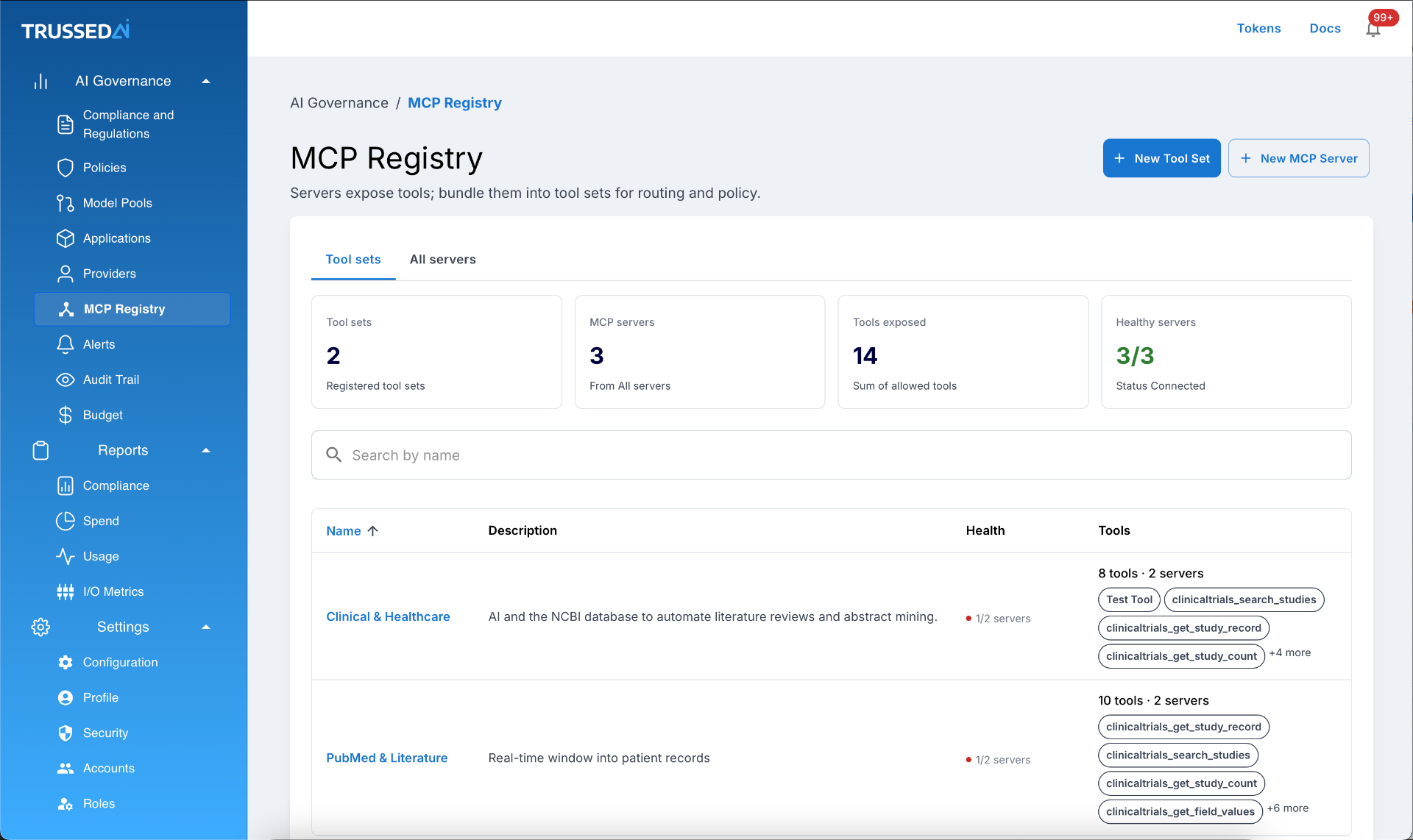
The gap between what insurance AI compliance requirements expect and what most AI governance programs currently produce is largely an enforcement gap. Written policy, model documentation, and periodic review describe intent; they do not, by themselves, generate evidence of what an AI agent did at a specific moment, under what authorization, and with what result.
Runtime governance addresses this gap by enforcing policy at the point an agent acts, rather than only at development or review checkpoints. Applied to insurance workflows, runtime controls give compliance teams the ability to show, for any given agent action, which policy governed it, what access was granted, and what occurred. This turns oversight expectations into something that can be demonstrated on request rather than described in a policy document.
Trussed AI provides runtime governance and security for enterprise AI agents, including agent identity, least-privilege permissions, tool approval workflows, runtime policy enforcement, and audit logging designed for the evidence requirements compliance teams face during examination.
Frequently Asked Questions
What regulations currently apply to AI in insurance?
The regulatory landscape is primarily state-driven, with NAIC model guidance playing a coordinating role. The NAIC's AI Model Bulletin sets expectations for governance, accountability, and oversight of AI-assisted decisions in areas such as underwriting and claims. Individual states have adopted, adapted, or are in the process of adopting these expectations, which means the specific requirements vary by jurisdiction. Carriers operating across multiple states must contend with a patchwork of requirements rather than a single uniform standard.
Does a model card or validation report satisfy insurance AI oversight requirements?
For static predictive models, model documentation and validation reports address a significant portion of regulatory expectations around explainability, testing, and design accountability. For AI agents that act autonomously at runtime, that documentation is necessary but not sufficient. It does not produce the action-level evidence regulators may request when examining whether a specific decision or data access was authorized and appropriate.
What makes an AI agent different from a predictive model for compliance purposes?
A predictive model produces a score or recommendation at a defined point in a workflow. An AI agent takes actions across systems, potentially invoking multiple tools, accessing multiple data sources, and making sequences of decisions during a single task. The compliance-relevant activity is continuous and distributed rather than discrete and centralized. This means the evidence requirements are also different: you need action-level logs, not only model-level documentation.
What does "least privilege" mean for an AI agent in an insurance workflow?
Least privilege means an agent is granted access only to the tools and data it needs for the specific task it is currently performing, not standing access to everything it might ever need. In an underwriting context, an agent processing a renewal should not have the same access as one handling a complex new commercial submission. Scoping permissions to the task reduces the blast radius of a failure and makes it easier to demonstrate that access was controlled and proportionate, both of which matter to regulators.
How does runtime policy enforcement differ from governance at deployment?
Governance at deployment reviews a system before it goes live: it covers configuration, access controls, and documentation. Runtime policy enforcement applies rules at the moment an agent attempts to take a specific action in a live workflow. The difference is that runtime enforcement creates a contemporaneous record that the policy was active and that the action was either permitted or blocked according to that policy. This record is the evidence layer that deployment-time review does not produce.
What should an audit log for an AI agent contain?
An effective audit log for an AI agent should capture, at minimum: the identity of the agent, the action attempted, the tool or system involved, the policy in effect at the time, the permissions that were granted or denied, the outcome of the action, and a timestamp. This allows a compliance team to reconstruct any agent action within a defined lookback period and answer specific regulator questions about what occurred and why it was authorized.