See how Trussed maps to SEC in 20 minutes

    No generic demo, just the controls relevant to your program.

    Book a session
    Compliance Guide

    Mapping AI Agent Controls to Compliance Requirements

    AI agent compliance controls are satisfied by mapping specific technical evidence, such as machine identity records, permission grants, and audit logs, to existing control categories in frameworks like SOC 2 and ISO/IEC 42001. Neither framework contains agent-specific requirements; compliance teams must translate agent behavior into the access, authorization, monitoring, and change-management criteria those frameworks already define.

    Compliance Guide  ·  AI Compliance and Governance

    Why Agent Behavior Needs Explicit Control Mapping

    SOC 2 and ISO/IEC 42001 were not written with autonomous AI agents in mind. SOC 2 is based on the AICPA Trust Services Criteria, covering categories such as Security, Availability, Processing Integrity, Confidentiality, and Privacy. ISO/IEC 42001 specifies requirements for an AI Management System (AIMS) covering governance, risk management, and controls across the AI system lifecycle. Both are general-purpose control frameworks that agent behavior must be mapped into, rather than standards written specifically for agentic AI.

    This creates a practical problem for compliance teams. An auditor examining SOC 2 Security criteria will ask how logical access is restricted and how users and system entities are authenticated before access is granted. An assessor reviewing ISO 42001 will ask how AI system operation is documented and traceable across its lifecycle. Neither question was designed around agents that act autonomously, hold their own permissions, and generate logs of their own decisions. The compliance work is to show, with technical evidence, that existing control intent is met even though the underlying system is an AI agent rather than a human user or a static application.

    Key principle: Compliance frameworks do not need to mention AI agents for them to apply. What matters is mapping agent-generated technical evidence to the control intent already defined in those frameworks.

    The Four Core Agent Controls

    Four categories of technical controls cover the majority of what auditors and assessors ask for when evaluating agentic systems. Each maps to specific criteria across SOC 2 and ISO/IEC 42001.

    Control Category What It Covers Compliance Relevance
    Identity Machine identity and authentication for autonomous agents SOC 2 logical access; ISO 42001 AI system traceability
    Permissions Least-privilege scoping and documented authorization SOC 2 access restriction criteria; ISO 42001 operational controls
    Audit Logging Traceable records of agent actions and decisions SOC 2 monitoring criteria; ISO 42001 lifecycle documentation
    Change Management Authorized, tested updates to agent access and configuration SOC 2 change management criteria; ISO 42001 operational governance

    SOC 2: Access, Authentication, and Change Management Criteria

    The most directly applicable SOC 2 requirements sit within the Security (Common) Criteria. These require that entities restrict logical and physical access through authorization, and identify and authenticate users and system entities before granting access. For an AI agent, the relevant evidence is a distinct machine identity, a record of how that identity was authenticated, and documentation showing what access was authorized and by whom.

    SOC 2 also requires monitoring of system components to detect anomalies indicative of malicious acts, errors, or disruption. Audit logs of agent actions serve this function directly, provided they capture enough detail to reconstruct what the agent did, when, and under what permission scope.

    Change management criteria are also relevant: any modification to an agent's permissions or configuration should be authorized, tested, approved, and implemented in a documented way, matching the same expectations applied to infrastructure or software changes.

    Evidence typically requested under SOC 2

    • Machine identity records showing how each agent is uniquely identified and authenticated
    • Access authorization documentation showing who approved the agent's permission scope
    • Audit logs capturing agent actions, timestamps, and the resources accessed
    • Change records for any modification to agent permissions or configuration
    • Monitoring alerts or anomaly detection outputs tied to agent behavior

    ISO/IEC 42001: AI Management System Controls

    ISO/IEC 42001 sets requirements for an AI Management System covering governance, risk management, and controls across the AI lifecycle. Its Annex A includes controls addressing AI system impact assessment, data management, and oversight of AI system use by third parties or suppliers. Agent-specific evidence maps into these areas where the agent's role, data access, and decision-making are treated as part of the AI system being managed.

    Where agents depend on external models, tools, or APIs, the third-party and supplier controls in Annex A become directly relevant. Organizations pursuing ISO 42001 certification should be able to show that agent-based systems were included in the required AI system impact assessment, and that oversight of any external components the agent relies on is documented rather than assumed.

    Evidence typically requested under ISO 42001

    • AI system impact assessment documentation that includes agent-based systems
    • Records of data access patterns and data handling for agent operations
    • Supplier or third-party oversight documentation for external models, tools, or APIs the agent relies on
    • Lifecycle documentation covering how agents are deployed, updated, and retired
    • Governance records showing accountability for agent behavior at an organizational level

    Documenting Agent Permission Changes for Audit

    Permission changes are one of the most frequently scrutinized areas during both SOC 2 audits and ISO 42001 assessments. When an agent's access scope is expanded, restricted, or transferred to a different role, that change should be captured with the same rigor applied to any other access-control modification.

    Practically, this means maintaining a record of the original permission state, the requested change, who authorized it, when it took effect, and whether any testing or review was completed before deployment. These records do not need to be held in a specialized system; what matters is that they are complete, retrievable, and tied to specific agent identities rather than generic service accounts.

    Common gap: Teams that manage agents through shared service accounts cannot produce agent-specific permission histories. Auditors will typically flag this as a control deficiency under both SOC 2 logical access criteria and ISO 42001 traceability requirements.

    NIST AI Risk Management Framework Alignment

    The NIST AI RMF is organized around four core functions: Govern, Map, Measure, and Manage. Unlike SOC 2 and ISO 42001, it does not produce a certification. Instead, it provides a vocabulary and structure for identifying, evaluating, and responding to AI-related risks. For compliance teams operating alongside engineering and risk functions, it can serve as a useful bridge between technical control implementation and organizational risk posture documentation.

    Agent controls map most directly to the Govern and Manage functions. The Govern function calls for defined policies, accountability structures, and workforce awareness. The Manage function covers response and recovery actions for identified AI risks. Audit logs of agent behavior, combined with defined escalation paths for anomalous actions, satisfy much of what NIST AI RMF asks for in these areas.


    Frequently Asked Questions

    Do SOC 2 auditors specifically ask about AI agents?

    Not typically by name, but the underlying questions are the same. Auditors ask how logical access is controlled, how system entities are authenticated, and how changes to access are authorized. If an AI agent holds permissions and acts on systems in scope, those controls apply. The burden is on the organization to show that the agent was treated as a system entity subject to the same access controls as any other component.

    Does ISO/IEC 42001 certification require agents to be explicitly listed in the AI system inventory?

    ISO 42001 requires organizations to define the scope of their AI Management System. If agents are in production and are part of the AI system being managed, they should be represented in the scope definition and included in the required impact assessment. Omitting agents from the scope when they are operationally significant would create a gap that assessors are likely to identify.

    Can a single audit log serve both SOC 2 and ISO 42001 requirements?

    Yes, provided the log captures the right fields. SOC 2 requires enough detail to detect anomalies and reconstruct what occurred. ISO 42001 requires documentation sufficient to demonstrate that the AI system operated within defined parameters. A log that captures agent identity, action taken, resource accessed, timestamp, and permission scope in effect at the time of the action will generally satisfy both frameworks. The log must be retrievable and tamper-evident to be credible as audit evidence.

    How should organizations handle agents that call external APIs or third-party models?

    Under ISO 42001, third-party dependencies in an AI system are subject to supplier oversight controls. Organizations should document which external services the agent relies on, what data is transmitted to those services, and what contractual or technical controls govern that relationship. Under SOC 2, if those external services are part of the system of record, their controls may need to be considered in the overall trust services boundary. Using a subservice organization's SOC 2 report, where available, is the standard way to address this.

    What is the practical first step for a compliance team new to agent governance?

    Start with inventory. Before any control mapping is possible, the organization needs to know which agents exist, what systems they can access, and what identities they operate under. Many teams discover that agents are running under shared service accounts with broad permissions, which makes per-agent evidence impossible to produce. Establishing distinct identities per agent, or per agent role, creates the foundation that all subsequent control mapping depends on.

    Turn Agent Controls Into Auditable Evidence

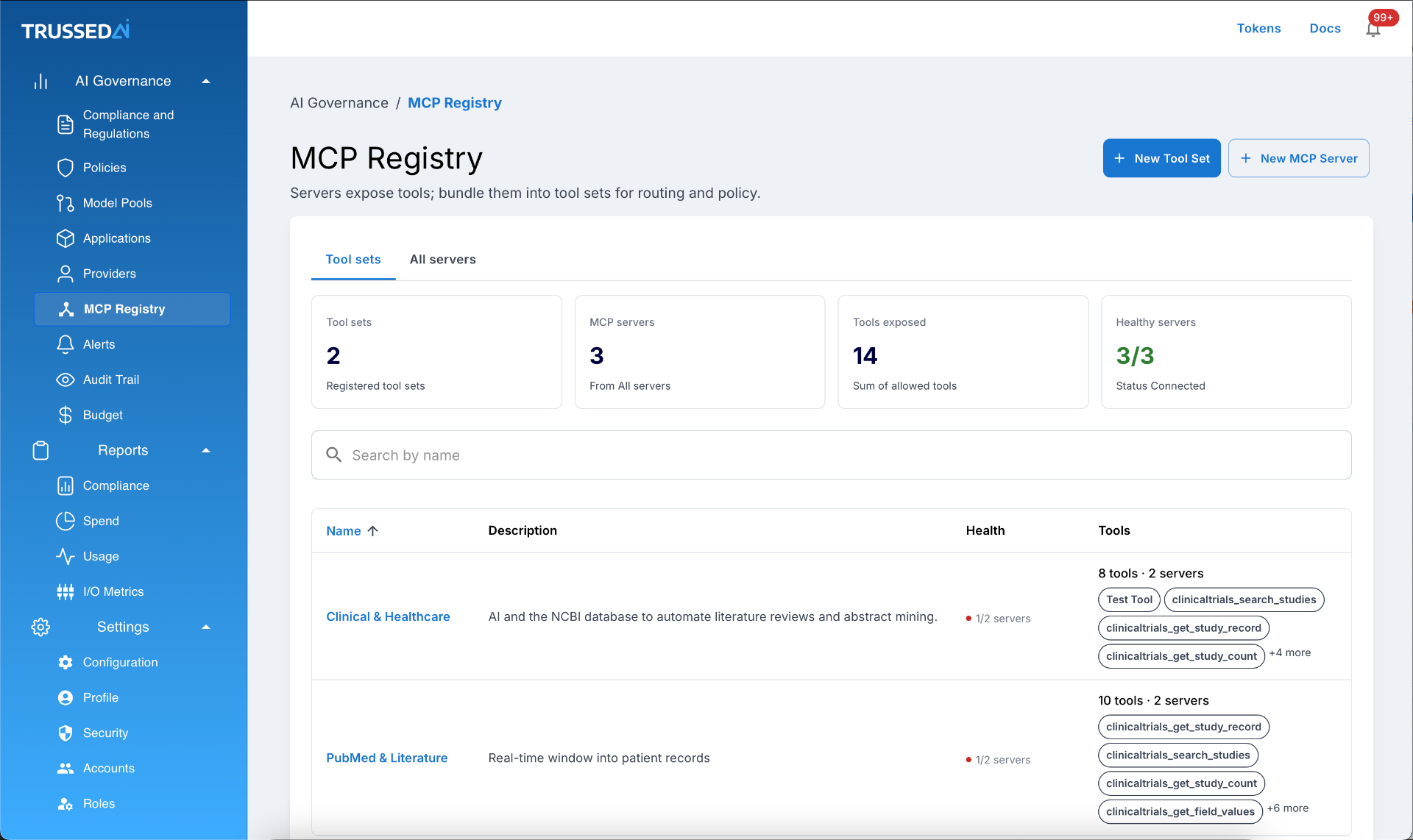
    Trussed AI provides runtime governance for AI agents, including identity, least-privilege permissions, and audit logging, to help compliance teams produce the technical evidence auditors ask for.

    Request a Demo