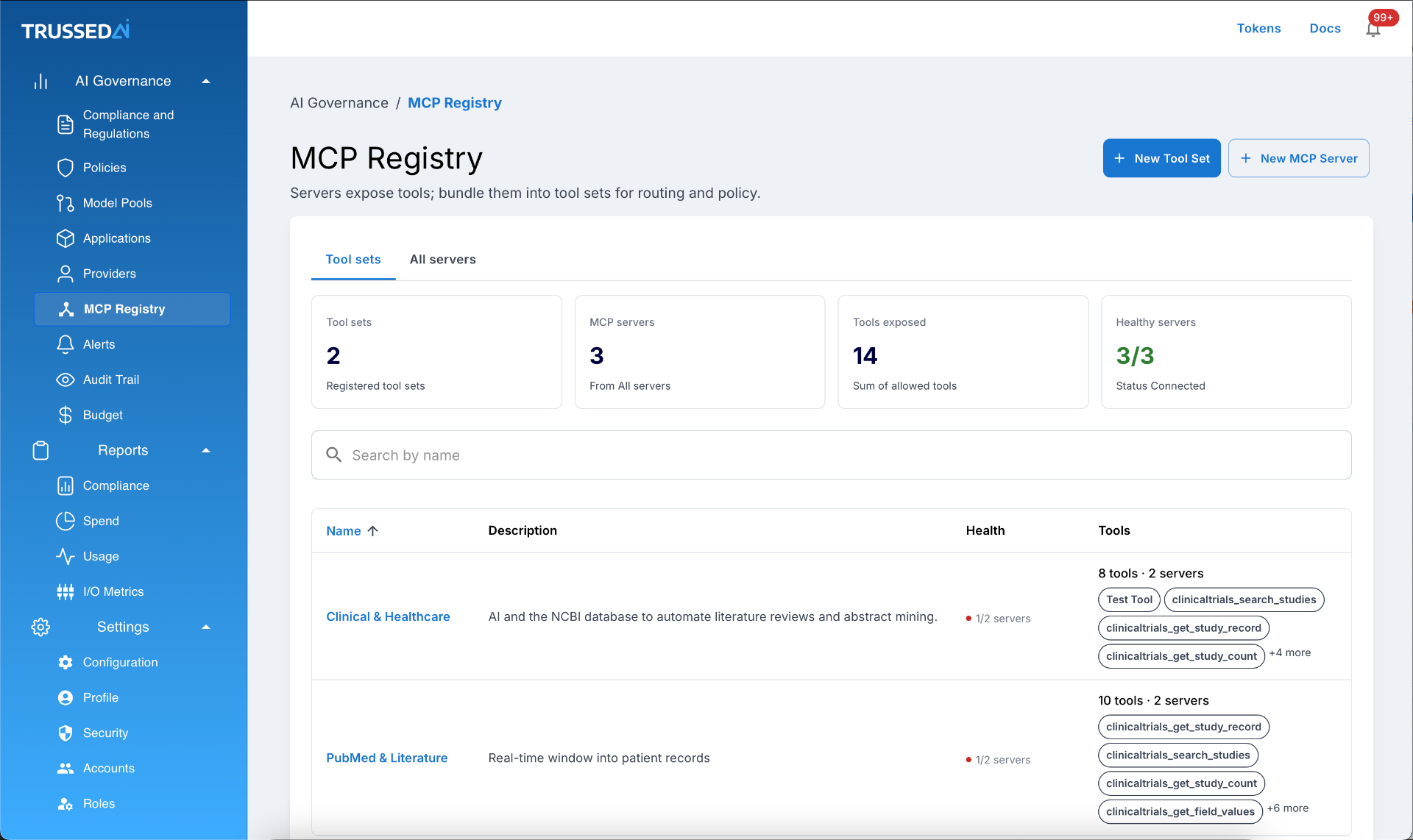
MCP Runtime Security Implementation for Enterprise AI Agents
Runtime security for MCP deployments requires four coordinated controls that operate at the moment of tool invocation, not just at connection setup: verified agent identity that persists across multi-step workflows, least-privilege scoping enforced at both the tool and parameter level, a policy enforcement point that cannot be bypassed by direct agent-to-server communication, and audit logging that reconstructs the full chain from agent decision to downstream system action.
The Four Runtime Controls MCP Deployments Require
Each of these controls addresses a distinct failure mode in agent-to-system communication. Together they form the minimum viable governance layer for any production MCP deployment.
| Control | What It Enforces |
|---|---|
| Agent Identity Verification | Confirmed per call, not assumed from initial session authentication |
| Least-Privilege Scoping | Enforced at the tool level and at the parameter level within each call |
| Runtime Policy Enforcement | A point of control that cannot be routed around by direct agent-to-server communication |
| Audit Logging | Correlates agent reasoning, tool calls, and downstream system responses into a single traceable record |
Why MCP Requires an Explicit Runtime Governance Layer
Model Context Protocol architectures typically separate an agent orchestrator (the client), a protocol layer, and one or more servers exposing tools and resources. This separation creates multiple points where identity checks and authorization decisions can be inserted, or quietly omitted.
Because tool invocation in agent frameworks generally follows a request/response pattern rather than a persistent, continuously verified session, an agent's identity and permissions must be re-validated at each call rather than assumed from an earlier authentication step.
For platform teams standing up MCP servers to connect agents to internal systems, this means runtime security cannot be treated as a byproduct of network access control. It requires a dedicated governance layer that operates at the point of tool invocation, independent of whichever team built the agent application.
Key implication
An agent authenticated at connection time can still issue calls that fall outside its intended scope if permission checks are not re-applied per invocation. Enforcement logic must evaluate each call independently against current policy.
Connection-Level Trust Is Not Sufficient
A common early-stage mistake in MCP deployments is treating a successful connection to an MCP server as equivalent to authorization for everything that server exposes. Because tool calls are discrete request/response events rather than continuous sessions, an agent authenticated at connection time can still issue calls that fall outside its intended scope if permission checks are not re-applied per invocation.
This has direct operational implications: permission scoping enforced only once, at session start, will not catch a case where an agent's task shifts mid-workflow and it begins invoking tools or requesting data outside its original intent.
Enforcement logic needs to evaluate each call independently against current policy, including checks on the parameters being passed, not only whether the tool itself is on an approved list.
- Re-validate agent identity on every tool invocation, not only at session establishment.
- Apply permission checks to the specific parameters being passed, not just the tool name.
- Evaluate calls against the policy state at time of invocation, accounting for mid-workflow task changes.
- Log each call independently so that a shift in agent behavior mid-workflow is detectable after the fact.
Implementation Decisions Before Onboarding an MCP Server
Platform teams should work through several structural questions before connecting a new MCP server to production agent workflows. Answering these early shapes both the enforcement architecture and the audit posture.
-
01
Define the scope of tools and resources the server will expose
Establish which tools an agent application can invoke and which data resources it can access. Keep this list as narrow as the intended workflow allows.
-
02
Decide where identity verification will occur
Determine whether identity is verified at a centralized gateway, within individual MCP servers, or both. Document the mechanism so it can be audited consistently.
-
03
Map enforcement placement to bypass risk
Confirm that no agent or plugin can reach a backend system without passing through the governed pathway. If a direct route exists, the enforcement layer provides an incomplete guarantee regardless of how well it is designed.
-
04
Establish audit logging requirements before go-live
Define the minimum log fields required to reconstruct a complete chain from agent decision to downstream system action. Agree with risk and compliance functions on retention period and access controls for log data.
-
05
Assign governance ownership separately from the application team
Ensure that server approval and permission scoping decisions sit with a team that does not also benefit directly from broader access grants.
Enforcement Placement and the Bypass Problem
Where the policy enforcement point sits has direct consequences for both consistency and risk.
Enforcement built into a centralized gateway or proxy is easier to audit and update consistently across a growing number of MCP servers, but it introduces a dependency: every MCP server must actually route through it.
Enforcement distributed across individual MCP servers avoids that single point of failure but makes it harder to guarantee consistent policy logic as the number of servers grows, and increases the burden of confirming every server implements checks correctly.
In either model, the practical question platform teams need to answer is whether an agent, or a plugin acting on its behalf, can reach a backend system directly without passing through the governed pathway. If that path exists, the enforcement layer provides an incomplete guarantee regardless of how well it is designed.
| Enforcement Model | Strengths | Risks |
|---|---|---|
| Centralized gateway | Consistent policy; easier to audit; single update point | Requires all servers to route through it; single dependency |
| Distributed per-server | No single point of failure; decentralized ownership | Policy drift across servers; higher verification burden |
| Hybrid | Balances consistency with resilience | More complex to maintain; requires coordination between teams |
The bypass test
Before treating an enforcement layer as effective, confirm that no agent or plugin can reach any governed backend system without passing through that layer. If a direct path exists, the enforcement provides only partial coverage.
Governance Ownership and Build-Versus-Buy
Runtime enforcement for MCP deployments works best when ownership for server approval and permission scoping sits separately from the teams building agent applications. This separation reduces the risk of permission requests being approved by the same team that benefits from broader access. It also supports a more defensible audit posture: risk and compliance functions generally need to demonstrate control effectiveness after the fact, which depends on enforcement and logging being consistent across every MCP server in use, not implemented ad hoc per project.
The build-versus-buy decision for this infrastructure should be evaluated primarily against the organization's ability to maintain consistent policy logic as the number of MCP servers increases. A custom enforcement layer that works for three servers may not scale cleanly to thirty without dedicated ownership and tooling.
Compliance requirements tied to the underlying systems and data an agent can reach, rather than the AI system itself, should set the minimum bar for audit detail and access control regardless of which approach is chosen.
- Separate governance ownership from the agent application team.
- Evaluate build-versus-buy against the number of MCP servers you expect to operate within twelve months.
- Set audit detail requirements based on the compliance obligations of the underlying systems being accessed.
- Treat policy consistency across all servers as a hard requirement, not a best effort.
Frequently Asked Questions
Why can't connection-level authentication serve as the authorization check?
Connection-level authentication establishes that an agent is who it claims to be at session start. It does not constrain what that agent does during the session. Because MCP tool calls are discrete request/response events, an agent's behavior can shift mid-workflow in ways that fall outside its original intended scope. Authorization must be re-evaluated per call to catch those shifts.
What should an audit log entry include at minimum?
At minimum, each entry should capture the verified agent identity, the tool invoked, the parameters passed, the policy decision applied, the response returned, and a timestamp. Ideally it also includes a trace or session identifier that links the call to the broader workflow context and the agent's stated reasoning, allowing a complete chain to be reconstructed later.
How do you handle least-privilege scoping when tool parameters vary at runtime?
Parameter-level enforcement requires policy rules that constrain allowable values, not just allowable tool names. For example, a file-read tool might be permitted, but only for paths within a defined directory prefix. Enforcement logic needs to evaluate the actual parameter values present in each call against those constraints, not assume that approval of the tool name implies approval of any parameters.
Is a centralized gateway always the right enforcement model?
Not necessarily. Centralized gateways simplify audit and policy consistency but introduce a routing dependency. Distributed enforcement avoids that dependency but risks policy drift across servers. The right model depends on your scale, team structure, and risk tolerance. In either case, the practical test is whether a bypass path exists: if an agent can reach a backend system without going through the enforcement layer, the model provides incomplete coverage regardless of how well it is designed.
Who should own MCP server approval in an enterprise?
Approval authority should sit with a team or function that does not also benefit directly from the access being granted. A platform engineering or security governance team is a common choice. This separation makes it harder for application teams to approve overly broad permissions for themselves, and it provides a cleaner audit trail for compliance reviews.
When does it make sense to build enforcement infrastructure rather than buy it?
Building is more defensible when your environment is highly specialized, your team has dedicated capacity to maintain the enforcement layer over time, and the number of MCP servers you operate is small and stable. As the number of servers grows, the cost of maintaining consistent policy logic across a custom implementation typically increases faster than the cost of adopting purpose-built tooling. Evaluate the decision against your twelve-month server count projection, not your current state.
Evaluate Your MCP Runtime Security Posture
Trussed AI provides runtime governance for AI agents, including identity verification, least-privilege enforcement, tool approval workflows, and audit logging for MCP-connected deployments.
Explore Runtime Governance