How does your AI governance program compare?

    See where your program has gaps in less than 2 minutes.

    Take the assessment
    Healthcare AI Compliance

    Physician Liability for AI-Assisted Diagnosis: Standard of Care Guide

    Physician liability for AI-assisted diagnosis generally turns on whether the clinician used the AI tool reasonably within the applicable standard of care, not on whether AI was involved by itself. AI recommendations should remain advisory unless the workflow, regulatory status, and institutional policy support a different use. A defensible enterprise program documents intended use, clinician review, tool limitations, escalation procedures, access controls, runtime policy enforcement, and audit records that show who used the tool, what it produced, and how the physician acted on it.

    Direct answer

    Physician liability for AI-assisted diagnosis generally turns on whether the clinician used the AI tool reasonably within the applicable standard of care, not on whether AI was involved by itself. AI recommendations should remain advisory unless the workflow, regulatory status, and institutional policy support a different use. A defensible enterprise program documents intended use, clinician review, tool limitations, escalation procedures, access controls, runtime policy enforcement, and audit records that show who used the tool, what it produced, and how the physician acted on it.

    What the standard of care means when AI supports diagnosis

    AI-assisted diagnosis does not eliminate the physician’s obligation to exercise independent clinical judgment. For compliance leaders, the practical issue is not whether an AI tool was present in the workflow. The issue is whether the organization can show that the tool was used within a reasonable, governed clinical process and that the physician retained meaningful oversight of the recommendation before acting on it.

    The standard of care is jurisdiction-specific and fact-dependent. It may consider the clinical context, patient presentation, physician specialty, available information, peer practice, institutional policies, and the known limitations of the technology. AI does not create a simple safe harbor, and FDA status alone does not resolve malpractice exposure. A cleared or authorized tool can still be misused. A non-device clinical decision support tool can still create risk if it is treated as authoritative, deployed outside its intended use, or allowed to influence care without adequate review.

    The most important compliance distinction is whether the clinician can independently review the basis for the recommendation. FDA clinical decision support guidance emphasizes intended use, user type, and whether a health care professional can independently evaluate the basis for the software output rather than relying primarily on it. That concept is directly relevant to enterprise risk management. If the workflow obscures the inputs, rationale, limitations, confidence context, or applicable patient population, it becomes harder to demonstrate that the physician used the tool as an aid rather than a substitute for judgment.

    Why regulatory status and intended use matter

    Healthcare organizations should classify each AI diagnostic tool before deployment. An AI system may be non-device clinical decision support, FDA-regulated software as a medical device, or part of certified health IT. The classification depends on intended use, functionality, user type, and implementation. Some AI-enabled diagnostic technologies appear on FDA’s public list of AI/ML-enabled medical devices, which illustrates that certain tools are regulated depending on their clinical claims and risk profile.

    This classification should not be treated as a procurement formality. It defines the operational boundaries for use. A tool designed to surface possible conditions for clinician review presents a different risk profile than a tool that drives triage, recommends orders, generates referrals, or initiates downstream actions. Compliance leaders should require a documented intended-use statement, approved clinical specialties, covered patient populations, contraindicated uses, and vendor-provided limitations before approving deployment.

    For certified health IT involving predictive decision support, ONC’s HTI-1 rule adds transparency and risk-management expectations. Relevant governance categories include validity, reliability, robustness, fairness, intelligibility, safety, security, and privacy. These categories are useful even when a particular standalone product is outside certified health IT requirements because they provide a practical structure for review. The organization should be able to explain what evidence was considered, which risks were accepted, which controls were implemented, and who owns ongoing monitoring.

    Governance evidence compliance teams should expect

    A defensible AI-assisted diagnosis program depends on evidence that can be reviewed after an event. The organization should maintain an inventory of diagnostic AI tools mapped to vendor, intended use, clinical location, regulatory status, model or software version, patient population, and owner. That inventory should be tied to approval records, risk assessments, and change-control decisions.

    Before deployment, clinical leaders should document the required human review steps. These should explain what the clinician must evaluate before relying on the output, including relevant inputs, limitations, confidence context, and conflicts with the patient record. Policies should also state when the tool may not be used and what escalation is required when the recommendation appears inconsistent, incomplete, or unsafe.

    Training is part of the control environment. Clinicians should understand appropriate reliance, known limitations, documentation expectations, override procedures, and how to report suspected errors or unsafe recommendations. Training should be specific enough to the tool and workflow that it does not become generic AI awareness education.

    After deployment, governance should continue. Monitoring should include real-world performance signals, drift indicators, adverse events, override patterns, user feedback, and workflow deviations. Change control should cover vendor updates, model changes, prompt or configuration changes, integration changes, and performance updates. If the tool changes materially, the organization should reassess whether the original intended use, validation evidence, training, and controls remain adequate.

    How enterprise AI governance frameworks fit the clinical workflow

    NIST AI RMF provides a useful structure for organizing clinical AI evidence around Govern, Map, Measure, and Manage. In a diagnostic setting, Govern assigns ownership and policy authority. Map identifies intended use, affected users, patient populations, data flows, and foreseeable misuse. Measure evaluates validity, reliability, safety, security, privacy, transparency, explainability, and fairness concerns. Manage defines treatment plans, monitoring, escalation, and retirement decisions.

    ISO/IEC 42001 provides another governance lens by specifying requirements for establishing, implementing, maintaining, and improving an AI management system. For healthcare organizations, the value is not in adopting a framework label. The value is creating a repeatable operating model that assigns accountability across compliance, clinical leadership, security, privacy, procurement, and IT operations.

    HIPAA technical safeguards also remain relevant. AI-assisted diagnosis workflows often involve electronic protected health information, so access control, audit controls, integrity controls, authentication, and transmission security should be part of the technical design. These safeguards do not answer the malpractice question directly, but they support defensible governance by showing that patient data access and system activity were controlled and recorded.

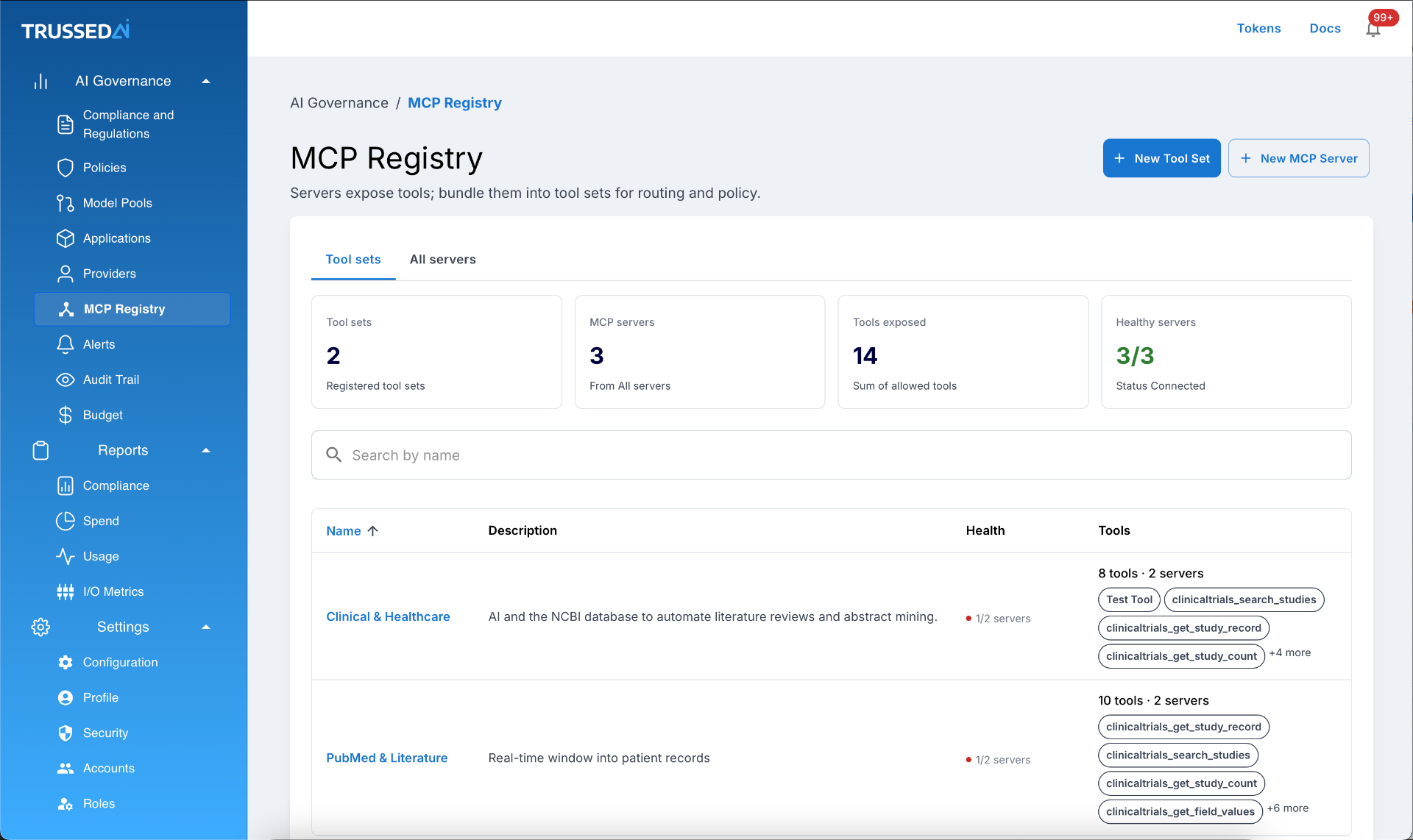
    Trussed AI supports runtime governance and security for enterprise AI agents in areas such as policy enforcement, agent identity, permissions, least privilege, tool approval workflows, runtime monitoring, and audit logging. In healthcare AI deployments, those capabilities are relevant where organizations need to enforce approved tool use and maintain traceability across AI-assisted workflows. They do not replace clinical governance, validation, or legal review.

    Runtime controls that reduce unmanaged medical AI liability

    Policy documents are necessary but incomplete. AI diagnostic workflows also need runtime controls that make the approved policy enforceable when clinicians and systems interact with the tool. The control objective is to prevent unauthorized use, preserve clinician oversight, and create a complete record of what occurred.

    1. 1

      Least-privilege access

      Access should be role-based and limited to users, specialties, and workflows covered by approved governance, training, and supervision.

    2. 2

      Tool-use boundaries

      Separate privileges should govern viewing recommendations, invoking diagnostic tools, changing prompts or configurations, approving outputs, and triggering downstream clinical actions.

    3. 3

      Runtime policy enforcement

      Controls should prevent tools from accessing unauthorized patient data, calling unapproved tools, or operating outside the approved diagnostic workflow.

    4. 4

      Clinician review separation

      The user interface and record should distinguish AI recommendations from final clinical decisions so independent physician review can be documented.

    5. 5

      Tamper-evident audit logs

      Logs should capture tool calls, inputs, outputs, user identity, timestamps, software version, clinician action, overrides, and escalation records.

    6. 6

      Escalation triggers

      Workflows should route low-confidence outputs, missing data, conflicting evidence, off-label use, unexpected behavior, and suspected safety events to defined review paths.

    AI diagnostic tool risk management checklist

    • Document whether the tool is FDA-cleared, FDA-authorized, FDA-exempt, or positioned as non-device clinical decision support, including the vendor’s stated basis.
    • Confirm that clinicians can independently review the basis for each recommendation, including inputs, limitations, and supporting rationale where available.
    • Define the approved clinical workflows, patient populations, prohibited uses, required human review steps, and escalation procedures.
    • Test role-based access, emergency access, agent permissions, tool approval workflows, and runtime policy enforcement before production use.
    • Verify that audit logs capture recommendation content, tool calls, patient context, user identity, timestamps, software version, clinician action, overrides, and downstream orders.
    • Require vendor and internal evidence for validation, security, monitoring, incident reporting, model updates, and change control.

    Evaluate runtime governance for AI-assisted diagnosis

    If your organization is deploying AI-assisted diagnostic workflows, assess whether permissions, policy enforcement, oversight records, and audit logs are strong enough to support defensible use.

    Talk to an Expert